


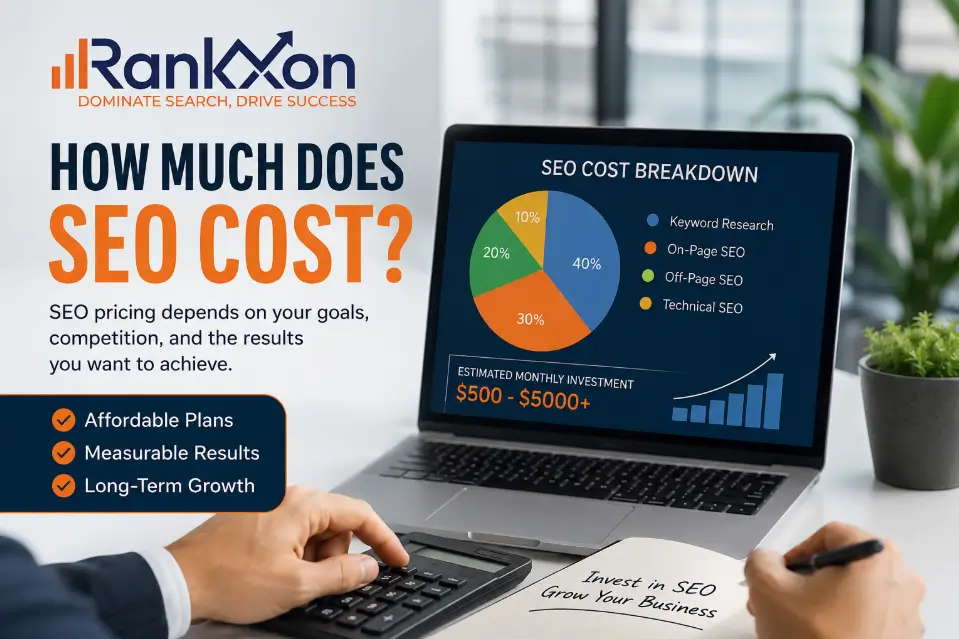
If you’ve searched for “How much does SEO cost?”, you’ve probably seen prices ranging from $300 to more than $10,000 per month. That leaves most business owners asking the same question:
Why is there such a huge difference, and what should I actually pay?
The truth is that SEO doesn’t have a fixed price. The right investment depends on your business goals, industry competition, website size, and the level of expertise needed to compete in search results.
For example, a local plumbing company targeting one city has very different SEO needs than an ecommerce brand selling products across the United States. The strategies, resources, and time involved are completely different, which directly affects pricing.
This guide explains how SEO pricing works in 2026, what influences the cost, what different service levels include, and how to choose an SEO plan that delivers real business growth. Whether you’re a startup, a local service provider, or an established company, you’ll leave with a clear understanding of what to expect before investing in SEO.
What Determines SEO Pricing?
No two SEO campaigns cost exactly the same because no two businesses face the same challenges. A local electrician trying to rank in one city doesn’t compete under the same conditions as a national ecommerce brand targeting thousands of keywords.
Professional SEO pricing is based on the amount of work required to achieve meaningful results not simply the number of hours worked. Understanding these factors makes it much easier to evaluate whether an SEO proposal is fairly priced.
Industry Competition
Competition is one of the biggest pricing factors.
Businesses operating in highly competitive industries need more content, stronger authority signals, better technical optimization, and ongoing improvements to outrank established competitors.
Industries such as legal services, healthcare, finance, roofing, and real estate typically require a larger investment because the competition is intense and the value of each new customer is much higher. Legal firms often require specialized optimization. Learn more about our legal SEO strategies to understand why competition is higher in this industry.
By comparison, businesses targeting a smaller local market with limited competition can often achieve strong results with a more modest monthly budget.
Website Size and Complexity
A five-page website is much easier to optimize than an ecommerce store with thousands of products.
Larger websites usually require:
- Technical SEO improvements
- Internal linking optimization
- Content updates across multiple pages
- Crawl and index management
- Structured data implementation
The more pages a website has, the more time is required to maintain and improve its organic performance.
Target Location
Your target market also influences pricing.
For example, ranking for local searches in a small town is generally less competitive than ranking in major cities like Los Angeles, New York, or Chicago.
Businesses targeting multiple cities or nationwide audiences often need additional landing pages, localized content, and broader authority-building efforts. Improving local search visibility helps businesses reach customers in the areas that matter most.
Business Goals
Your objectives matter just as much as your industry.
If your goal is to generate a handful of local leads each month, your SEO strategy will look very different from a company trying to dominate an entire market.
Higher growth goals usually require:
- More content production
- More competitive keyword targeting
- Advanced technical SEO
- Ongoing performance analysis
- Continuous optimization
The greater the ambition, the greater the investment required.
SEO Cost by Industry
Different industries demand different levels of SEO investment because customer value, competition, and search behavior vary significantly.
The table below provides a realistic starting point for businesses evaluating their SEO budget.
| Industry | Typical Monthly SEO Budget | Competition Level |
|---|---|---|
| Law Firms | $3,500–$10,000+ | Very High |
| Dentists | $2,000–$6,000 | High |
| Healthcare Providers | $2,500–$7,500 | High |
| Home Services (HVAC, Roofing, Plumbing) | $2,000–$6,500 | High |
| Ecommerce Stores | $3,000–$10,000+ | Very High |
| Professional Services | $1,500–$5,000 | Medium to High |
| Cannabis Businesses | $3,000–$8,000 | High |
Every industry has its own challenges.
For example, healthcare websites must build trust while complying with higher content quality expectations. Law firms compete for some of the most valuable local keywords, while ecommerce businesses often manage hundreds or even thousands of product pages that require continuous optimization. Businesses selling products online usually need an online store growth strategy designed for large product catalogs.
Businesses looking for industry-specific strategies often achieve better results with specialized campaigns rather than generic SEO packages. Whether you operate an ecommerce store, healthcare practice, legal office, or contractor business, a customized strategy usually delivers stronger long-term growth than a one-size-fits-all approach.
Dental practices often benefit from customized dental marketing strategies that focus on attracting qualified local patients.
SEO Pricing in Los Angeles
Businesses in Los Angeles often invest more in SEO than companies in smaller cities, and there’s a simple reason why.
Los Angeles is one of the most competitive digital markets in the United States. Nearly every industry from law firms and medical practices to contractors and ecommerce brands is competing for the same customers.
That competition increases the amount of work needed to earn top rankings.
A successful SEO campaign in Los Angeles often includes:
- Comprehensive keyword research
- Local landing pages
- Google Business Profile optimization
- High-quality content creation
- Technical website improvements
- Authority-building through trusted backlinks
- Continuous monitoring and reporting
While businesses in smaller markets may succeed with a limited SEO budget, companies targeting Los Angeles usually benefit from a more comprehensive long-term strategy.
Businesses competing locally often work with Los Angeles experts who understand the city’s highly competitive search landscape.
What Do You Actually Get for Your SEO Investment?
One of the biggest frustrations business owners have is not knowing what an SEO package actually includes.
Price alone tells you very little.
Instead of comparing agencies based only on monthly fees, compare the work being delivered.
| Monthly Budget | Typical Deliverables |
| $1,500–$2,000 | Technical improvements, keyword research, on-page optimization, local SEO, monthly reporting |
| $2,500–$4,000 | Everything above plus content creation, competitor analysis, internal linking, conversion improvements |
| $5,000–$7,500 | Advanced technical SEO, authority building, digital PR support, content strategy, ongoing optimization |
| $10,000+ | Enterprise SEO, large-scale content production, multiple markets, advanced analytics, dedicated SEO team |
When reviewing proposals, ask exactly what is included.
A quality SEO campaign should explain:
- Which pages will be optimized
- How often new content will be published
- Whether technical improvements are included
- How keyword performance will be tracked
- How success will be measured
Transparent agencies define the scope of work before the campaign begins, making it easier to understand where your investment is going.
Cheap SEO vs Professional SEO
Every business wants to control costs, but SEO is one area where choosing the cheapest option often creates expensive problems later.
Here’s a practical comparison.
| Cheap SEO | Professional SEO |
| Generic strategies | Customized strategy |
| Automated content | Human-led content planning |
| Low-quality backlinks | Authority-focused link building |
| Minimal reporting | Clear performance reporting |
| Short-term tactics | Sustainable long-term growth |
| Focus on rankings only | Focus on rankings, leads, and revenue |
Professional SEO isn’t about doing more work it’s about doing the right work consistently.
Businesses should be especially cautious of extremely low-priced SEO packages that promise instant rankings or guaranteed first-page results. Sustainable SEO takes planning, expertise, and ongoing refinement.
The next step is understanding how to choose the right SEO provider and determine whether the investment is likely to generate a positive return. That’s exactly what we’ll cover in the next section.
How to Choose an SEO Agency Without Overpaying
Choosing an SEO agency isn’t about finding the lowest price. It’s about finding the right partner.
A professional SEO agency should explain its strategy, define realistic expectations, and clearly show how your investment supports your business goals.
Before signing an agreement, ask these questions:
- What services are included each month?
- How will success be measured?
- How often will I receive reports?
- Who will be working on my website?
- What results should I expect within six to twelve months?
- Have you worked with businesses in my industry?
Clear answers demonstrate experience. Vague promises usually don’t.
Red Flags to Watch For
Avoid agencies that:
- Guarantee #1 Google rankings.
- Promise results within a few weeks.
- Build hundreds of backlinks every month without explaining their process.
- Refuse to explain what work they’ll perform.
- Lock clients into long contracts without transparency.
SEO should be based on strategy, quality, and continuous improvement not shortcuts.
Is SEO Worth the Cost?
For businesses that depend on online leads or sales, SEO is often one of the highest-return marketing investments.
Unlike paid advertising, organic visibility can continue generating traffic long after content has been published and optimized.
For example, a local business spending $2,500 per month on SEO doesn’t need thousands of visitors to see a return. If organic search consistently brings qualified prospects who become paying customers, the investment can quickly outperform many other marketing channels.
The real question isn’t “How much does SEO cost?”
It’s “How much revenue could I lose by remaining invisible in search results?”
What Return on Investment Can You Expect?
SEO doesn’t produce overnight results, but it creates long-term business value.
Businesses that invest consistently often experience:
- Higher-quality website traffic
- More qualified inquiries
- Lower customer acquisition costs over time
- Increased brand visibility
- Better conversion opportunities
Instead of focusing only on rankings, measure SEO using business metrics such as:
- Organic leads
- Phone calls
- Contact form submissions
- Revenue generated
- Cost per acquisition
- Customer lifetime value
Those numbers provide a much clearer picture of SEO performance than rankings alone.
How Long Does SEO Take?
SEO is a long-term growth strategy.
While every website is different, the timeline below reflects what many businesses can realistically expect.
| Timeline | What Usually Happens |
|---|---|
| Month 1 | Technical audit, keyword research, strategy development, website improvements |
| Months 2–3 | Content optimization, local SEO improvements, early keyword movement |
| Months 4–6 | Stronger rankings, increased organic traffic, more qualified leads |
| Months 6–12 | Continued authority growth, higher visibility, sustainable lead generation |
Highly competitive industries may require additional time, especially when competing against well-established websites.
SEO Pricing Trends for 2026
SEO continues to evolve as search engines become more sophisticated.
Today, successful SEO campaigns go far beyond keywords.
Businesses are investing in:
- Better user experience
- Helpful, experience-driven content
- Technical website performance
- Structured data
- Brand authority
- AI-friendly content organization
Search platforms now evaluate content based on usefulness, expertise, and trustworthiness rather than simple keyword repetition.
Companies that consistently publish valuable content while improving their websites are more likely to maintain long-term visibility.
Frequently Asked Questions
How much does SEO cost for a small business?
Most small businesses invest between $1,500 and $3,000 per month, depending on their goals, competition, and location.
How much does SEO cost per month?
Professional monthly SEO services generally range from $1,500 to $5,000, while larger businesses often invest significantly more.
How much does SEO cost per hour?
Experienced SEO consultants typically charge between $100 and $250 per hour, depending on their expertise and the complexity of the project.
Is SEO worth paying for?
Yes, if your goal is sustainable business growth. A well-planned SEO strategy can continue generating qualified traffic and leads long after the initial work is completed.
Can I do SEO myself?
Basic SEO tasks can be learned and implemented independently. However, competitive industries usually require advanced technical knowledge, content strategy, and ongoing optimization that experienced professionals provide.
Does Google charge for SEO?
No.
Google doesn’t charge businesses to appear in its organic search results. SEO involves improving your website so it earns better visibility naturally.
Why do SEO prices vary so much?
Pricing depends on several factors, including competition, website size, business goals, target locations, and the amount of work required to achieve measurable results.
Is SEO still effective in 2026?
Absolutely.
SEO continues to evolve alongside AI-powered search experiences, but businesses that create helpful content, maintain technically sound websites, and build authority remain well positioned to attract organic traffic.
Conclusion
SEO isn’t just a cost it’s a long-term investment in your business’s visibility, customer acquisition, and growth. The right budget depends on your industry, competition, and goals, so focus on a strategy that delivers measurable results rather than choosing the cheapest option.
A tailored approach often works best, whether you’re targeting ecommerce, healthcare, legal, home services, or other specialized industries. If you’re unsure where to start, contact our team for a personalized consultation we’ll assess your needs and recommend a strategy built around your goals.
If you’re unsure which SEO plan fits your business, schedule a free strategy call to receive personalized recommendations.
