


You check your rankings in the morning and suddenly a page that was performing well starts slipping. Traffic drops. Impressions stay stable, but clicks and engagement weaken. Most website owners immediately blame backlinks, content length, or another Google update.
In many cases, the real issue is much simpler.
Users are landing on the page, not finding what they expected, and returning to Google within seconds.
That behavior matters more than most SEO metrics people obsess over. Understanding modern ranking signals requires more than just technical optimization.
This is where the confusion between bounce rate and pogo sticking starts. Many marketers treat them as the same thing even though they measure completely different user actions. One can be completely normal. The other often signals that your page failed to satisfy search intent.
Understanding the difference can help you improve rankings, reduce user drop-offs, and create pages that keep visitors engaged instead of pushing them back to search results.
In this guide, you will learn:
- the real difference between bounce rate and pogo sticking
- how Google interprets user behavior
- why high bounce rates are not always bad
- what causes pogo sticking
- and how to improve engagement without chasing vanity metrics
Bounce Rate vs Pogo Sticking: The Core Difference
Although these terms are often grouped together, they describe different behaviors.
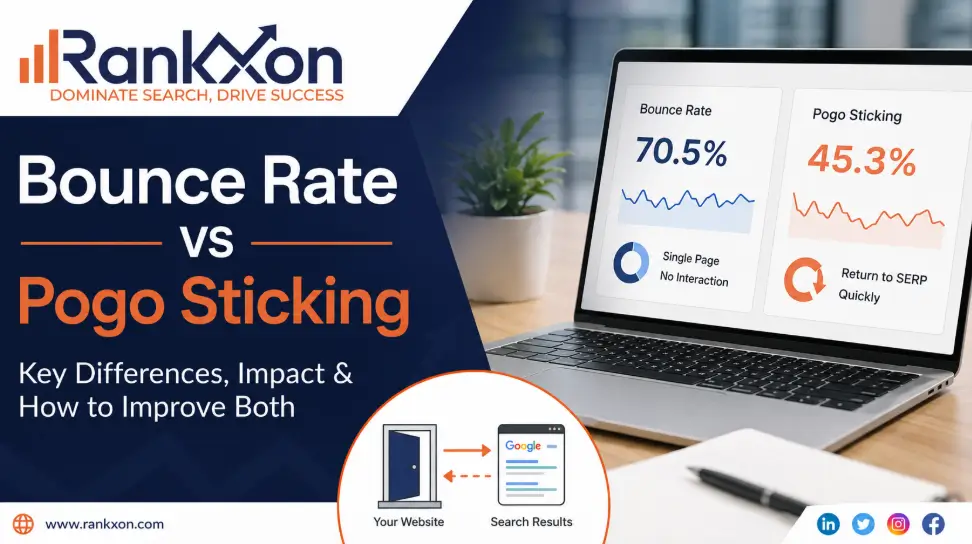
Bounce rate measures whether a user visited only one page before leaving your website. Pogo sticking describes a user returning to Google search results quickly because the page did not satisfy their query.
Here is the simplest way to understand it.
| Feature | Bounce Rate | Pogo Sticking |
|---|---|---|
| User Action | Leaves after viewing one page | Returns to Google search results quickly |
| Can It Be Good? | Yes | Usually no |
| Related to Search Intent? | Sometimes | Directly |
| SEO Impact | Context dependent | Signals dissatisfaction |
| Time Factor | Any duration | Usually within seconds |
| Common Cause | Single-page session | Poor relevance or user experience |
A visitor can spend five minutes reading your article, get their answer, and leave without clicking another page. That is still a bounce, but it is not a bad experience.
Pogo sticking is different.
If someone searches for “best running shoes for flat feet,” clicks your page, realizes it contains generic advice, and immediately returns to Google to click another result, that signals frustration.
The difference comes down to satisfaction.
What Is Bounce Rate in SEO?
Bounce rate is the percentage of users who leave a website without taking another action such as clicking another page, filling out a form, or interacting with the site further.
For years, marketers treated bounce rate like a direct SEO scorecard. That created a lot of bad advice.
A high bounce rate does not automatically mean your content is poor.
Imagine someone searching:
- weather in Los Angeles
- WhatsApp customer support number
- currency converter
- SEO checklist PDF
If the page answers the query immediately, the user may leave after one page because they already got what they needed.
That session still counts as a bounce.
The important question is not:
“Did they leave?”
The important question is:
“Did they leave satisfied?”
How GA4 Changed Bounce Rate
This is where many outdated SEO articles fail.
Google Analytics 4 changed how bounce rate works. Instead of focusing only on page exits, GA4 measures engagement more intelligently.
A session is considered engaged if users:
- stay longer than 10 seconds
- trigger a conversion event
- or view multiple pages
That means modern SEO requires more context than simply watching bounce percentages.
A 70% bounce rate on a blog post may be completely normal.
A 30% bounce rate on a landing page with poor conversions may still indicate problems.
Without context, bounce rate alone means very little.
What Is Pogo Sticking?
Pogo sticking happens when users click a search result, leave quickly, and return to Google to try another result.
This behavior often happens because:
- the content did not match the search intent
- the page loaded too slowly
- the title was misleading
- the content looked untrustworthy
- the user experience created friction
Unlike bounce rate, pogo sticking happens directly inside the search journey.
That is why SEOs pay close attention to it.
A Simple Example
A user searches:
“best CRM software for startups”
They click your article.
Instead of comparisons, pricing, and recommendations, they find a vague introduction stuffed with keywords. Within seconds, they hit the back button and choose another result.
That is pogo sticking.
The page attracted the click but failed to keep attention.
Why Pogo Sticking Matters More Than Bounce Rate
Google’s entire business depends on delivering useful search results.
If users repeatedly return to search results after clicking a page, it suggests the result may not have solved the problem properly.
Google has never officially confirmed pogo sticking as a direct ranking factor. However, user satisfaction signals clearly matter in modern search.
Search engines analyze patterns such as:
- query reformulation
- repeat searches
- click behavior
- engagement depth
- long clicks versus short clicks
This is why some pages lose rankings even with strong backlinks and technically optimized SEO.
They satisfy algorithms but fail real users. Even websites with strong backlinks and authority signals can struggle if users consistently return to search results after clicking.
Does Google Use Bounce Rate as a Ranking Factor?
Google has repeatedly said that bounce rate itself is not a direct ranking factor.
That statement is important because many SEO myths still treat bounce rate like a penalty signal.
The confusion exists because people mix up bounce rate with user satisfaction.
Google may not care about a simple bounce metric from Analytics, but it absolutely cares whether users find value in search results.
That distinction changes how you should approach SEO.
Instead of obsessing over reducing every bounce, focus on:
- matching intent
- improving readability
- answering queries quickly
- and keeping users engaged naturally
That approach aligns much more closely with how modern search works. Many SEO myths still misunderstand how engagement metrics influence visibility, especially when discussing bounce rate signals and rankings.
What Google Probably Measures Instead
This is where the conversation becomes more useful.
Modern SEO is less about isolated metrics and more about behavioral patterns.
Dwell Time
Dwell time refers to how long users stay on a page before returning to search results.
If users spend several minutes engaging with your content, it usually signals relevance and satisfaction.
Long Clicks vs Short Clicks
A long click happens when users click a result and remain engaged without immediately returning to Google.
A short click happens when they leave quickly and continue searching.
Long clicks suggest success.
Short clicks often suggest disappointment.
Query Refinement
Google also observes how users modify searches.
For example:
- “best budget laptop”
- “best budget laptop under $500”
- “best budget gaming laptop under $500”
These refinements help search engines understand whether earlier results solved the query properly.
Search Intent Satisfaction
This is the real foundation behind pogo sticking.
If your page aligns with what users expect, engagement improves naturally.
If the content misses the intent, users leave regardless of word count or keyword density.
Bounce Rate Can Be Completely Normal
This is one of the biggest misconceptions in SEO.
Not every page is supposed to create long sessions.
Some pages are designed to answer questions quickly.
Examples include:
- contact pages
- calculators
- weather pages
- definitions
- quick tutorials
- phone numbers
- pricing lookups
If users get the answer immediately, leaving is not failure.
Trying to force unnecessary clicks can actually damage the user experience.
Good SEO focuses on satisfying intent first.
Common Causes of Pogo Sticking
Most pogo sticking problems come from mismatched expectations.
Here are the most common reasons users return to search results quickly.
Weak Search Intent Match
If someone searches for “best email marketing tools” and lands on a basic definition article, the intent mismatch becomes obvious immediately.
Slow Page Speed
Users rarely wait for slow websites anymore. Delays increase frustration and abandonment. Users rarely wait for slow websites anymore. Delays increase frustration and abandonment, especially when core technical SEO issues slow page performance.
Misleading Headlines
Clickbait titles attract clicks but destroy trust.
If your title promises:
“Complete SEO Strategy Guide”
but the page contains shallow advice, users leave quickly.
Poor Mobile Experience
Most traffic now comes from mobile devices. Tiny text, intrusive popups, and cluttered layouts create friction instantly.
Thin Content
Surface-level articles no longer compete well.
Users expect:
- depth
- clarity
- examples
- structure
- and practical insights
How to Reduce Pogo Sticking
Reducing pogo sticking is not about tricks. It is about creating pages that satisfy users faster and more clearly.
Match Search Intent Early
Your introduction should immediately confirm users are in the right place.
Do not bury answers under generic introductions. Strong content optimization helps users confirm immediately that they landed on the right page.
Improve Above-the-Fold Content
The first screen matters heavily.
Users should instantly see:
- relevance
- clarity
- structure
- and trust signals
Make Content Easier to Scan
Large blocks of text push users away.
Use:
- clear headings
- concise paragraphs
- tables
- examples
- and visual separation
Improve Internal Linking
Guide users naturally toward related pages.
This keeps engagement flowing without forcing clicks.
Optimize for Mobile Devices
Fast-loading mobile pages improve both user experience and engagement.
Bounce Rate Benchmarks by Website Type
There is no universal “perfect” bounce rate.
Different industries behave differently.
| Website Type | Typical Bounce Rate |
|---|---|
| Blogs | 60%–80% |
| Ecommerce Stores | 20%–45% |
| SaaS Websites | 25%–55% |
| Landing Pages | 60%–90% |
| Local Business Sites | 35%–60% |
Context matters more than raw numbers.
An informational blog naturally produces more single-page sessions than an ecommerce product page.
Bounce Rate vs Dwell Time vs Pogo Sticking
These terms are connected but not interchangeable.
| Metric | What It Measures | SEO Meaning |
|---|---|---|
| Bounce Rate | Single-page session | Context dependent |
| Dwell Time | Time before returning to search | Engagement quality |
| Pogo Sticking | Quick SERP return | Search dissatisfaction |
Understanding these differences helps you diagnose performance issues more accurately.
How to Identify Pogo Sticking in GA4
Google Analytics does not directly show pogo sticking, but you can detect patterns indirectly.
Watch for:
- high exits with very low engagement time
- weak scroll depth
- declining organic rankings
- low interaction rates
- pages with high CTR but poor retention
Combining GA4 with Google Search Console creates a clearer picture of user behavior.
For example:
- high impressions
- strong click-through rate
- but declining rankings
often suggest users clicked but did not stay engaged. Combining GA4 with Search Console and a detailed site performance audit can reveal pages losing engagement after search clicks.
The Biggest SEO Myth About Bounce Rate
The biggest mistake marketers make is treating bounce rate like a universal quality score.
It is not.
A high bounce rate on a blog can be completely healthy.
A low bounce rate on a confusing landing page can still produce terrible results.
SEO works best when you stop chasing isolated metrics and start focusing on user satisfaction.
That is the real connection between bounce rate and pogo sticking.
Conclusion
Bounce rate and pogo sticking are not the same thing, and understanding that difference changes how you approach SEO.
Bounce rate simply measures whether users stayed on one page.
Pogo sticking reflects whether your content failed to satisfy search intent.
Modern SEO is moving away from vanity metrics and toward behavioral understanding.
The pages that perform best today are not always the longest or the most optimized for keywords. They are the pages that solve problems quickly, clearly, and better than competing results.
If users land on your page and feel confident they found the right answer, rankings usually follow. Businesses struggling with engagement signals and declining rankings often benefit from experienced SEO growth guidance focused on user intent and behavioral optimization.
