


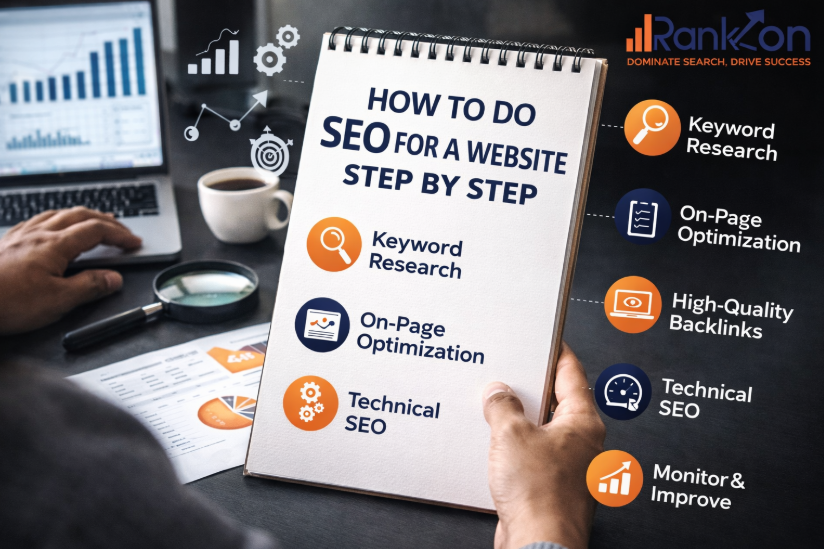
Most websites don’t fail because SEO is complicated.
They fail because there is no clear system behind the effort.
If your site has zero traffic, this step by step guide will show you what actually works.
You don’t need expensive tools or years of experience to start.
You need a clear process that connects every action to results.
This guide is built to take you from confusion to your first real traffic.
If you follow each step in order, things will start making sense.
And more importantly, you will start seeing results instead of guessing.
What SEO Actually Does for Your Website (In 2 Minutes)
SEO is the process of making your website visible on search engines.
When your content matches what users search, Google places it higher.
Higher rankings bring consistent traffic without paying for ads.
Search engines scan your pages, understand content, then rank them based on multiple ranking signals. They analyze keywords, structure, and trust signals before deciding positions. That’s why every step in this guide builds on the previous one.
If you skip one step, the whole system weakens over time.
So before jumping into keywords, your setup must be correct first.
Before You Start: 3 Things You Must Set Up (Most People Skip This)
Many beginners jump directly into writing content without preparation.
Then they complain that their pages are not ranking or even showing.
If Google cannot properly read your site, nothing else will work.
Set up Google Search Console
This is where you track how your site performs in search results.
You can see which keywords bring traffic and which pages are indexed.
It also allows you to submit pages directly for faster indexing.
Without this tool, you are working blindly without real data.
That makes it impossible to improve your SEO strategy over time. If you are unsure about your site’s current condition, running a quick site audit can reveal hidden issues.
Set up Google Analytics
This tool shows how users behave once they visit your site.
You can track time spent, pages viewed, and user engagement.
This helps you understand what content is working and what needs fixing.
When combined with Search Console, you get a full picture.
One shows search performance, the other shows user behavior.
Submit your sitemap and check indexing
A sitemap helps search engines discover your website pages easily.
Without it, some pages may stay hidden and never get indexed.
Indexing is required before any page can rank on Google.
Once your setup is complete, you are ready for keyword research.
This is where your actual SEO journey begins.
Step 1: Find the Right Keywords (Don’t Skip This or Nothing Works)
Keyword research is the foundation of your entire SEO strategy, and learning a proper keyword planning method makes a huge difference.
If you choose the wrong keyword, your content will never rank.
The right keyword connects your content directly to user demand.
How to find keywords using Google (free method)
Start by typing your topic into Google search.
Look at autocomplete suggestions and related searches below results.
These phrases come from real users and reflect actual demand.
You can also check “People also ask” for more ideas.
This helps you understand what questions users want answered.
How to pick low-competition keywords
Avoid broad keywords because they are dominated by big websites.
Instead, choose longer phrases with clear and specific intent.
Long-tail keywords give beginners a realistic chance to rank.
For example, instead of “SEO tips,” choose something specific.
A better option would be “SEO for new website step by step.”
How to understand search intent
Search your keyword and study the top results carefully.
Check if they are guides, lists, or product pages.
Your content must match this intent to have any chance of ranking.
If Google shows guides, you must write a detailed guide.
This is exactly what connects your keyword research to on-page SEO.
Step 2: Set Up Your Website for SEO (Technical Basics Made Simple)
Now your keywords are ready, but your site must support them.
If your website is slow or poorly structured, rankings will suffer.
Technical SEO ensures your site is accessible and trusted by Google, especially when you follow proper technical optimization basics.
Make your site mobile-friendly
Most traffic now comes from mobile devices, not desktops.
If your site is not optimized for mobile, users will leave quickly.
This increases bounce rate and reduces ranking potential.
Improve page speed (quick wins)
Page speed directly impacts both user experience and rankings.
Compress images, reduce plugins, and use a fast hosting provider.
Even a small delay can cause users to exit your page.
Create clean URLs and structure
Your URLs should be short, readable, and keyword-focused.
Avoid unnecessary numbers or confusing parameters in links.
Clear structure helps search engines understand your content better.
Now that your site is technically ready, you move into optimization.
This is where your page starts becoming competitive.
Step 3: Optimize Your Pages (On-Page SEO That Actually Works)
On-page SEO transforms your content into something Google can rank, and mastering on-page improvements gives you a strong advantage.
It ensures your page is clear, structured, and relevant to the keyword.
Every small detail here contributes to better visibility.
Write titles that rank and get clicks
Your title must include the keyword naturally and clearly.
It should also create curiosity so users want to click.
A strong title improves both rankings and click-through rate.
How to use keywords naturally
Place your keyword in the introduction and headings.
Then use related terms throughout the content naturally.
Avoid repeating the same keyword too often.
Internal linking strategy (simple method)
Link your content to other relevant pages on your website.
This improves navigation and distributes authority across pages.
It also increases the time users spend on your site.
Now that your page is optimized, content quality becomes critical.
This is where most rankings are actually decided.
Step 4: Create Content That Google Wants to Rank
Content is the main factor behind successful SEO.
Even perfect optimization cannot fix weak or useless content.
Your content must solve the user’s problem clearly and completely.
What helpful content really means
Helpful content answers the user’s question without confusion.
It should be simple, structured, and easy to follow.
Focus on solving one problem instead of covering everything.
How to structure a ranking article
Break your content into clear sections with proper headings.
Use short paragraphs and logical flow between ideas.
This improves readability and keeps users engaged longer.
Content vs competition (what makes you better)
Your content must be clearer and more actionable than competitors.
Add examples, steps, and real explanations instead of theory.
This is how you stand out in competitive search results. Strong content also works better when supported by a complete off-page strategy.
Step 5: Get Your First Backlinks (Without Paying or Spamming)
Backlinks are one of the strongest ranking signals in SEO, and using the right link building methods can speed up your growth.
They show Google that other websites trust your content.
Without backlinks, ranking becomes slow and difficult.
Beginner-friendly backlink methods
- Submit your website to relevant directories
- Share content in niche communities
- Reach out to small bloggers for collaboration
What to avoid completely
Avoid buying low-quality backlinks from random sources.
These links can damage your site instead of helping it grow.
Focus on building real and relevant connections.
Step 6: Track Results and Improve (What to Check Weekly)
SEO is a continuous process, not a one-time task.
Tracking performance helps you understand what is working.
Without tracking, you cannot improve your results.
What you should monitor weekly
- Keyword rankings
- Website traffic
- Click-through rate
When and how to update content
If your page is not improving, update it with better information.
Add clarity, improve structure, and fix keyword targeting.
This keeps your content fresh and competitive over time. For businesses targeting specific areas, combining this with local search optimization can bring faster results.
SEO Workflow Summary (Follow This System)
| Step | Action | Result |
|---|---|---|
| Keyword Research | Choose low competition keywords | Faster ranking chances |
| Technical Setup | Fix speed and indexing | Better crawling |
| On-Page SEO | Optimize content elements | Higher visibility |
| Content Creation | Solve real problems | More engagement |
| Backlinks | Build authority | Strong rankings |
| Tracking | Analyze and improve | Continuous growth |
SEO for New Websites: 30-Day Action Plan
This is where everything becomes practical and actionable.
Instead of guessing, you follow a clear weekly roadmap.
This plan is designed to get your first results quickly.
Week 1
Set up tools, fix technical issues, and submit your sitemap.
Week 2
Find one keyword and plan your first content piece.
Week 3
Publish your optimized content and improve structure.
Week 4
Start building backlinks and monitor performance.
Why Your SEO Is Not Working (Fix These First)
Most SEO problems come from simple mistakes.
Fixing these can significantly improve your results.
Ignoring them will keep your site stuck without growth.
- Choosing highly competitive keywords
- Publishing weak or generic content
- Not building backlinks
- Lack of consistency
If you are still struggling after fixing these, getting expert SEO guidance can save time and effort.
How Long Does SEO Take to Work (Real Expectations)
SEO is a long-term strategy that requires patience.
Results do not appear instantly, even with correct steps.
Understanding the timeline helps you stay consistent.
- First 1 to 3 months for indexing
- 3 to 6 months for early rankings
- 6 months and beyond for steady growth
Frequently Asked Questions (FAQs)
1. How do I start SEO for my website?
Start by setting up tracking tools and making sure your site is indexed. Then choose one low competition keyword and create content around it. Focus on one page first instead of trying to optimize everything at once.
2. Can I do SEO by myself without hiring an expert?
Yes, you can handle basic SEO on your own. Most beginners get results by learning simple steps like keyword research and content optimization. You only need expert help later when scaling or handling advanced technical issues.
3. How long does SEO take to show results?
SEO usually takes a few months to show noticeable results. New websites may take longer due to low authority. If you stay consistent and follow the right steps, you will start seeing progress within 3 to 6 months.
4. Is SEO still worth it in 2026?
Yes, SEO is still one of the most effective ways to get long term traffic. Search engines now focus more on quality and user experience. If your content genuinely helps users, SEO will continue to work for your website.
5. Do I need paid tools to do SEO?
No, you can start SEO using free tools like Google Search Console and Google Analytics. These are enough for beginners. Paid tools become useful later when you want deeper insights and faster growth.
6. What is the most important step in SEO?
Keyword research is the most important step because it decides your direction. If you target the wrong keywords, your content will not rank. Choosing the right keyword increases your chances of getting traffic quickly.
7. Why is my website not ranking on Google?
Common reasons include targeting competitive keywords, weak content, or lack of backlinks. Sometimes your site may not be indexed properly. Fix these issues first before expecting any ranking improvements.
8. How many pages should I create for SEO?
Start with one high quality page instead of creating many low quality ones. Once that page performs well, expand gradually. Consistency and quality matter more than publishing too many pages quickly.
Conclusion: What You Should Do Next
SEO does not require perfection, it requires consistency and the right direction. You now understand how each step connects, from keyword research to content and backlinks. The key is to avoid overthinking and take action. Start with one keyword, create one strong page, and improve it over time. Focus on clarity, usefulness, and user intent instead of trying to game the system. If you stay consistent and keep learning from your results, your website will gradually gain visibility, traffic, and trust in search engines.
