
Why Better Businesses Stay Invisible on Google Maps
You have the reviews, the experience, and the track record. Your competitor has half of that. Yet they’re sitting in the top three on Google Maps and your phone isn’t ringing.
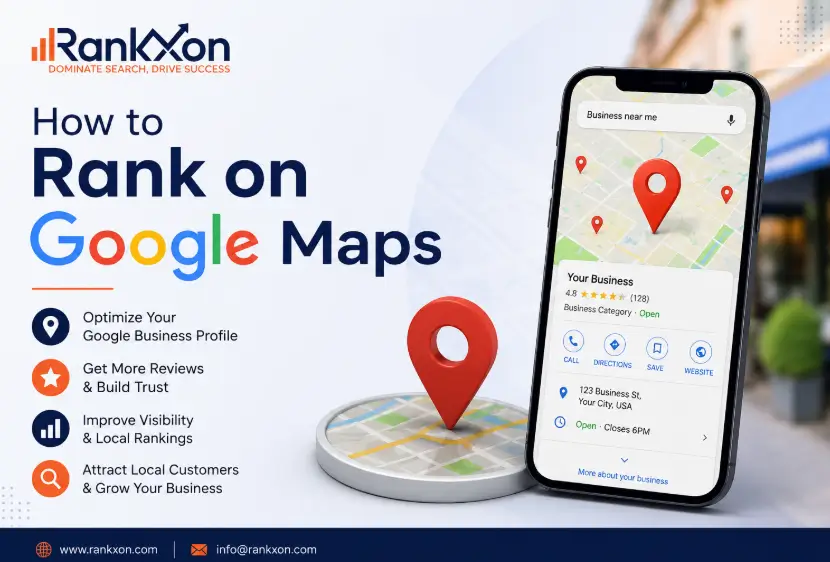
Google Maps doesn’t reward the best business. It rewards the most optimized one. Most business owners think ranking is about collecting reviews and filling out a profile. Meanwhile, competitors who understand the algorithm are pulling every local lead in your area. Most businesses struggle because they lack a proper local visibility strategy that aligns with how Google Maps evaluates trust and relevance.
Here’s what’s actually going on.
How Google Maps Ranking Actually Works
Google officially ranks Maps results on three factors: relevance, distance, and prominence.
-
Relevance is how well your Google Business Profile matches the search query. If someone searches “emergency plumber near me” and your profile never mentions emergency services, Google won’t make the connection.
-
Distance is how close your business is to the searcher. You can’t fully control this, but you can control everything else.
-
Prominence is how trusted and well-known your business appears online, based on reviews, backlinks, citations, and profile activity.
| Factor | How to Influence It |
|---|---|
| Relevance | Optimize every GBP field with accurate service and location language |
| Distance | Set service areas correctly, choose your address location strategically |
| Prominence | Build reviews, local backlinks, citations, and consistent brand presence |
What Google doesn’t publicize is that behavioral signals now carry serious weight. Clicks on your listing, calls made from Maps, direction requests, and website visits all tell Google how real users respond to you. A listing with strong engagement can outrank one with more reviews over time.
Google Maps Ranking Factors in 2026
Google Business Profile Optimization
Your primary GBP category is the single most important field in your entire profile. Choose the most specific, accurate category for your core service. A family dentist should select “Family Dentist,” not just “Dentist.”
Beyond category, fill every section: a real business description with your services and city, accurate hours, a matching phone number, services with descriptions, attributes, and a seeded Q&A section. Google treats profile completeness as a trust signal. Working with profile optimization experts can help businesses fully optimize categories, services, and engagement signals.
Reviews: Quantity, Quality, and Recency
Raw review count matters less than most people think. Google weighs recency heavily. A listing with 200 reviews where the last one came six months ago can rank below one with 80 reviews getting five per month consistently.
Review content matters too. “Great experience” does nothing compared to “best emergency plumber in Phoenix, fixed a burst pipe in under an hour.” That kind of review gives Google real service and location context.
Respond to every review. Use natural service and location language in your responses. It looks authentic and feeds Google additional relevance signals.
Local Citations and NAP Consistency
Citations are online mentions of your business name, address, and phone number. The real problem for most businesses isn’t having too few citations. It’s having inconsistent ones. If your address appears differently across Yelp, Apple Maps, and various directories, Google sees conflicting signals and loses confidence in your listing. Before building more listings, businesses should focus on proper citation cleanup to avoid conflicting signals.
Audit first, then build. Fix what’s broken before adding more.
Website SEO Signals
Your website feeds directly into your Maps prominence score. A site with locally relevant content, proper schema markup, and inbound links from local sources tells Google you’re a real, trusted local business. A weak website with no local content actively holds down your Maps ranking. A weak website with unresolved technical SEO issues can actively hold down your Maps ranking
Behavioral Signals
This is where most guides stop short. Google watches how users interact with your listing in real time. Consistent clicks, calls, and direction requests are interpreted as demand signals. This is why some businesses seem to appear from nowhere and suddenly rank well. They’re earning trust through activity, not just completeness.
Local Backlinks and Brand Mentions
A mention in a local news article, a listing on your chamber of commerce site, or a feature in a city blog creates local authority that’s very hard for competitors to replicate quickly. In 2026, even unlinked brand mentions carry weight because Google’s AI systems are better at processing contextual references across the web. Consistent authority building through local mentions and backlinks helps strengthen prominence signals
Step-by-Step: How to Rank Higher on Google Maps
-
Verify your GBP. An unverified listing has almost no ranking potential. Do this first.
-
Choose the right primary category. Specific beats broad every time.
-
Fill every GBP section. Description, services, products, attributes, Q&A. Leave nothing blank.
-
Upload photos weekly. Two to three new images per week signals an active, current business.
-
Build a review system. Follow up with every customer via text or email with a direct review link. Keep it simple and consistent.
-
Respond to reviews strategically. Include natural service and location language in your responses.
-
Fix your citations. Audit NAP consistency across all directories before building new ones.
-
Create real location pages. Each service in each city you serve needs its own page with genuine, useful content, not thin placeholder text.
-
Publish weekly Google Posts. Post about promotions, completed work, seasonal services, or local events. Keeps your profile fresh.
-
Track rankings with a geo-grid tool. You can’t fix what you can’t see.
Well structured local SEO pages help Google understand service relevance across cities
Why Competitors With Fewer Reviews Still Outrank You
This is the most frustrating question in local SEO, and the answer is usually one of these:
Proximity. If their address is closer to where most searches originate, they win the distance factor regardless of how good your reviews are.
Spam listings. Some competitors stuff keywords into their business name (“Dallas Emergency Plumber | ABC Services”). This violates Google’s guidelines but works short-term. Report them through Google’s Business Redressal Complaint Form.
Better engagement signals. They might be getting more clicks and calls from Maps than you, even with fewer reviews. Google interprets that as preference.
Stronger local authority. Backlinks from local sites, more consistent citations, and a better-connected website all feed into prominence in ways reviews alone can’t overcome.
Google Maps SEO Mistakes Killing Your Rankings
-
Inconsistent NAP across directories. Even minor differences drag down your authority signals.
-
Fake reviews or review gating. Google’s spam detection is significantly better in 2026. Getting caught means review removal or listing suspension.
-
No recent Google Posts. An inactive profile looks like an inactive business.
-
Wrong primary category. This single mistake limits every search you can rank for.
-
Thin location pages. “We serve Dallas” with three sentences does nothing. Write real content.
-
Slow mobile experience. Most local searches happen on mobile. A slow site sends negative signals back to Google.
A complete SEO audit process often reveals hidden issues affecting Maps visibility
How AI Search Is Changing Google Maps SEO
Google AI Overviews now influence local search results at scale. When someone asks an AI-powered query with local intent, Google pulls data from GBPs, website content, review summaries, and trusted third-party sources to construct its answer.
Businesses that appear in these AI-generated responses have stronger entity signals: consistent business information across the web, structured schema data, rich review profiles on multiple platforms, and content that directly answers questions customers are asking.
Entity SEO is the concept behind this. Your business is an entity in Google’s knowledge graph. The more consistently your name, address, services, and identity appear across the web, the more confidently Google can categorize and recommend you, both in Maps and in AI-generated answers.
To improve your AI search visibility:
-
Add FAQ sections to your location and service pages
-
Implement Local Business schema markup on your website
-
Build reviews on Yelp, Apple Maps, and industry directories, not just Google
-
Earn mentions on trusted local sites, not just backlinks
Many businesses now seek SEO consulting support to improve entity signals and AI visibility
Google Maps SEO Checklist for 2026
Weekly:
-
Publish one Google Post
-
Upload two to three new photos
-
Respond to all new reviews across platforms
-
Check GBP Insights for click and call trends
Monthly:
-
Audit GBP for accuracy (hours, address, services)
-
Run a citation consistency check
-
Review geo-grid rankings for position changes
-
Publish one new location or service page on your website
-
Check Core Web Vitals in Google Search Console
Frequently Asked Questions
How long does Google Maps SEO take?
Basic optimizations can show results in 30 to 60 days. Competitive markets typically take 3 to 6 months of consistent effort.
Can I rank on Google Maps without a storefront?
Yes. Service area businesses can hide their address and set a service area. You’ll still rank, though businesses with visible addresses have a slight advantage.
Why do my rankings fluctuate daily?
Maps rankings change based on the searcher’s exact location, device, query phrasing, and real-time behavioral data. This is normal. Geo-grid tools help you see average positioning across your area.
Does website SEO affect Maps rankings?
Yes, directly. Your website’s authority, local content, and schema markup all feed into your Maps prominence score.
Can I do this myself?
Yes, for the foundational work. Profile optimization, photos, reviews, and posts are manageable without professional help. Competitive link building, technical SEO, and entity optimization are harder to execute well without experience.
Conclusion
The businesses winning on Google Maps in 2026 aren’t necessarily the biggest or the most reviewed. They’re the most consistent. Complete profile. Active engagement. Real authority signals. Content that proves expertise.
Google wants to show the most relevant, trustworthy, and active local business for every search. Make that choice obvious, and Maps becomes a predictable lead source instead of a mystery.
