
Your rankings are fine. Your traffic is dropping.
That is the situation a lot of SEO managers walked into this year. The page sits at position three on Google, but clicks have fallen 20-30% because ChatGPT, Perplexity, and Google’s AI Overviews are answering the question before anyone scrolls down to click.
Traditional on-page SEO isn’t broken. But it’s no longer enough on its own. If your content isn’t structured for AI systems to read, extract, and cite, you’re invisible in the places where your audience is actually searching now.
This guide walks you through the 10-step AI search content optimization checklist that covers both sides: ranking on Google and getting cited by AI tools. Each step is practical. Each one has a specific action you can take this week.
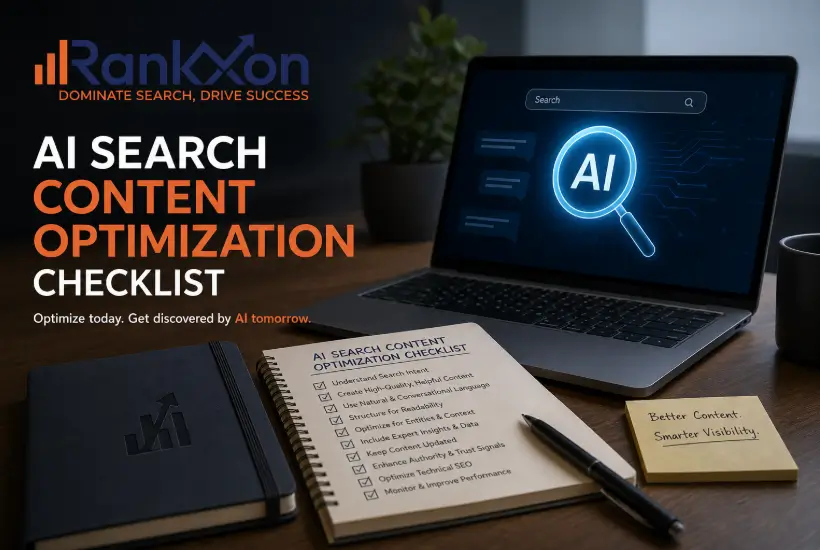
We also put together a free AI Search Content Optimization Checklist you can copy and use right now. It covers all 10 steps with tasks, priority levels, status tracking, and tool recommendations in one place. No signup needed.
The 10 steps are: (1) Map AI audience behavior, (2) Fix AI crawlability, (3) Build topical depth, (4) Use answer-first structure, (5) Apply schema markup, (6) Use semantic/entity keywords, (7) Build E-E-A-T signals, (8) Add multi-modal content, (9) Write for personalization resilience, (10) Monitor AI citations. Details and tools for each step follow below.
What Is AI Search Optimization (and Why It’s Different)
Traditional SEO targets one thing: getting your page ranked for a specific keyword. AI search optimization, sometimes called GEO (Generative Engine Optimization), targets something different: getting your content used as a source when an AI system synthesizes an answer.
The difference matters because the mechanics are different. Google ranks pages. ChatGPT, Perplexity, and Google AI Overviews extract chunks of information from multiple sources and blend them into a single answer. Your page doesn’t need to rank first. It needs to be the clearest, most trustworthy source on a specific sub-question within a topic.
Think of traditional SEO as getting a librarian to shelve your book at eye level. AI search optimization is convincing the librarian to quote your book when someone asks a question. The skills overlap, but they’re not the same thing. A solid on-page SEO foundation is still required, but it won’t get you cited on its own.
The 10-Step Checklist at a Glance
Use this table as your working reference. We explain each step in full below.
| Step | Action | Priority | Quick Win? |
| 1 | Map how your audience searches on ChatGPT, Perplexity, Gemini | High | Yes |
| 2 | Fix robots.txt to allow AI crawlers (GPTBot, ClaudeBot, Google-Extended) | High | Yes |
| 3 | Build topical depth with a content hub around your main topic | High | No (ongoing) |
| 4 | Rewrite intros to answer the question in 40 words or less | High | Yes |
| 5 | Add FAQSchema + HowToSchema to key pages | Medium | Yes |
| 6 | Use semantic/entity keywords, not just exact match | Medium | Yes |
| 7 | Add author bios, original data, external brand mentions | Medium | No (ongoing) |
| 8 | Add images, video embeds, and alt text for multi-modal queries | Medium | Yes |
| 9 | Write for general questions, not overly niche/local angles | Low | No |
| 10 | Track AI citations weekly using tools like Profound or Semrush AI | High | Yes |
Step 1: Map How Your Audience Searches on AI Platforms
Before you optimize anything, you need to know where your audience is searching. Not every industry has moved to AI-first search at the same pace. B2B SaaS buyers are asking Perplexity long research questions. Consumers are asking ChatGPT product questions. Local service queries still happen mostly on Google.
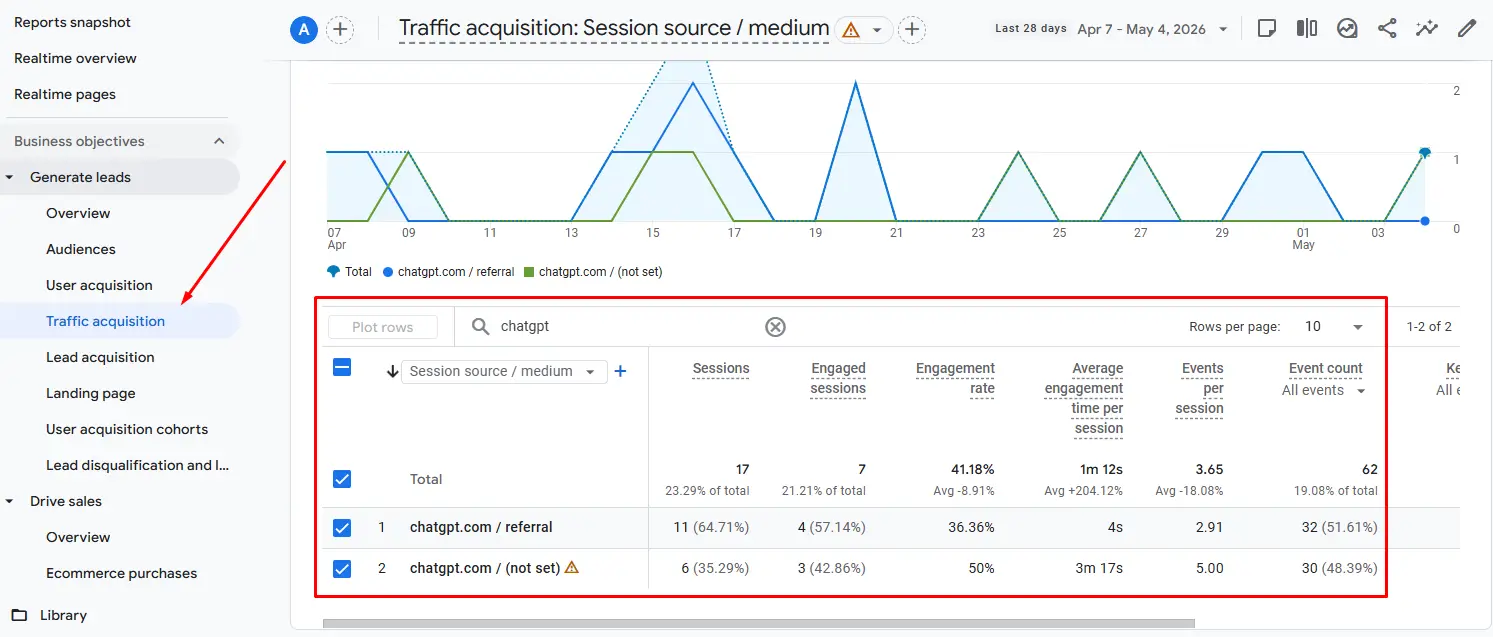
Start by checking your Google Analytics 4 referral sources. Look for traffic from chat.openai.com, perplexity.ai, and similar domains. Then use a tool like Semrush or Similarweb to check where your competitors get AI-referred traffic.
The real value here is understanding what people ask, not just what keywords they search. AI queries tend to be longer, more conversational, and task-oriented. ‘Best CRM for small business under 50 employees’ replaces ‘best CRM.’ Your content needs to answer both.
Action: Spend 30 minutes reviewing your referral traffic in GA4. Note which AI platforms are sending visitors, even small amounts, and research what prompts your competitors are ranking for.
- Check GA4 referral sources for AI platform traffic
- Use Semrush AI or Profound to identify popular prompts in your niche
- List the top 10 conversational questions your ICP would ask an AI about your topic
Step 2: Make Sure AI Crawlers Can Actually Access Your Site
This one gets overlooked constantly, and it can make everything else pointless. If your robots.txt is blocking AI crawlers, no amount of optimization will get you cited.
Several major AI systems use their own crawlers. GPTBot crawls for OpenAI. ClaudeBot crawls for Anthropic. Google-Extended feeds Google AI Overviews. Many sites that added aggressive bot-blocking rules in 2023 and 2024 accidentally blocked all of them.
Open your robots.txt file right now. If you see Disallow: / applied broadly, or if GPTBot and ClaudeBot aren’t explicitly allowed where you want them, fix it. A thorough SEO audit should include checking AI crawler access as a standard item.
- Check robots.txt for GPTBot, ClaudeBot, Google-Extended, PerplexityBot
- Confirm that important content pages are not behind JavaScript rendering that AI crawlers can’t parse
- Test page speed: most AI systems skip slow pages, aim for under 2.5s LCP
Step 3: Build Topical Depth, Not Just a Single Article
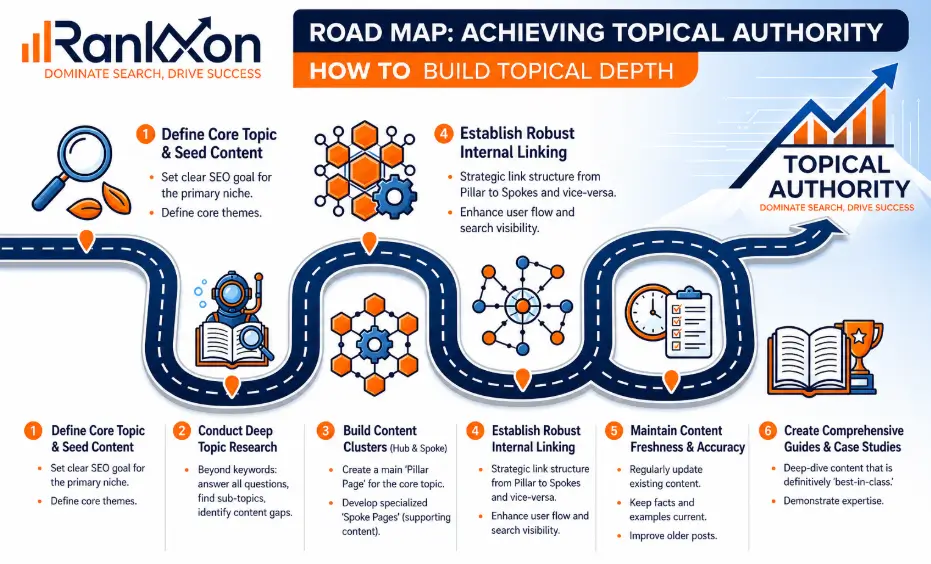
One well-written article does not make you an authority on a topic. AI systems look at your site’s overall coverage of a subject when deciding whether to cite you. A single post about AI search optimization, sitting on a site with no related content, gets cited less often than a page on a site with a full content cluster around the topic.
Build a content hub. Your main ‘pillar’ page covers the broad topic. Supporting pages go deeper on specific subtopics. Internal links connect them.
For RankXon, this means this checklist post should link to and from pages on technical SEO, keyword research, and related service pages. The site’s topical authority builds up over multiple pages, not just one.
Each supporting page should answer a distinct question that connects back to the main topic. Thin supporting pages hurt more than they help.
- Map out 5-8 supporting topics that connect to your main topic
- Check that existing related pages have clear internal links between them
- Identify any topic gaps where competitors have coverage and you don’t
Step 4: Structure Every Page to Answer First
AI systems extract answers from content. They’re much more likely to extract a clean, direct answer that appears near the top of the page than to piece one together from scattered paragraphs buried in the middle.
The pattern is simple: state the answer clearly in the first 40-50 words after the H1. Then back it up with detail, context, and supporting evidence. This is sometimes called the ‘inverted pyramid’ style, common in journalism.
Bad example: Starting with ‘In today’s rapidly changing digital landscape, content optimization has become increasingly important…’ and burying the actual answer in paragraph four.
Good example: ‘AI search content optimization is the process of structuring your content so AI systems like ChatGPT and Google’s AI Overviews can extract, understand, and cite it. It involves answer-first formatting, topical depth, schema markup, and crawlability fixes.’
Write clean H2 and H3 headings that state the question or key point directly. Keep paragraphs to 2-3 lines. Use short sentences. Each section should be extractable on its own.
- Review your top 5 pages: does each one answer the main question within the first 50 words?
- Rewrite any intro that starts with a generic statement instead of an answer
- Check that each H2 and H3 would make sense as a standalone answer snippet
Step 5: Add Schema Markup (FAQ, HowTo, Article)
Schema markup is structured data that tells search engines and AI systems exactly what type of content is on a page. Without it, an AI crawler has to guess what your content means. With it, the context is explicit.
For a checklist post like this one, the most useful schema types are FAQPage (for the Q&A sections), HowTo (for step-by-step instructions), and Article (for the overall post metadata including author and publish date).
FAQSchema is particularly valuable because it creates a direct mapping between questions and answers. AI systems love well-labeled Q&A pairs. Pair schema with solid on-page SEO and you’re covering both the traditional and AI ranking signals at the same time.
- Add FAQPage schema to any page with a Q&A section
- Add HowTo schema to step-by-step guides and checklists
- Add Article schema with author name, publish date, and modified date
- Validate all schema using Google’s Rich Results Test before publishing
Step 6: Use Semantic and Entity Keywords
Keyword stuffing is dead for traditional SEO. It’s even more harmful for AI search. Language models understand meaning, not just matching strings. A page that uses ‘AI search optimization’ fifteen times but never mentions ‘ChatGPT,’ ‘Perplexity,’ ‘LLM,’ ‘generative AI,’ or ‘AI Overviews’ signals shallow coverage.
Entity-based writing means covering the related concepts, tools, people, and platforms that naturally belong to a topic. If you’re writing about AI search optimization, the entities include specific AI platforms, named tools, known frameworks (E-E-A-T, GEO), and related concepts (crawlability, schema, topical authority).
A solid keyword research process should now include semantic clusters, not just volume-ranked lists. The ‘People Also Search For’ data from Google (shown above in the brief) is a direct map of related entities and concepts you should be covering.
- Identify the 10-15 entities most closely associated with your main topic
- Use NLP tools (Semrush, Clearscope) to check semantic coverage before publishing
- Make sure you mention specific AI platforms, tools, and frameworks by name
Step 7: Build E-E-A-T Signals That AI Systems Trust
Google uses E-E-A-T (Experience, Expertise, Authoritativeness, Trustworthiness) as a quality framework. AI systems look for similar signals when deciding which sources to cite. A page with a vague byline, no author bio, and no external mentions of the brand gets cited less often than one with clear authorship and external credibility signals.
The most important E-E-A-T improvements are often the simplest: add a real author bio that includes actual credentials, link to the author’s LinkedIn or social profiles, include original data or first-hand experience where possible, and build a consistent presence across industry publications.
Original research is particularly powerful. If your content includes a statistic, case study, or finding that doesn’t exist elsewhere, AI systems are more likely to cite it specifically. Combine this with strong off-page SEO to get the external brand mentions that reinforce your authority signal.
- Add a detailed author bio with credentials to every blog post
- Link the author bio to external profiles (LinkedIn, Twitter/X, industry sites)
- Include at least one original data point, case study, or first-hand observation per post
- Build external brand mentions through PR, guest posts, and industry directories
Step 8: Add Multi-Modal Content (Images, Video, Structured Visuals)
AI platforms are increasingly multimodal. Google AI Overviews pull in image carousels. Perplexity shows video thumbnails. A text-only page is less competitive than one with properly labeled images, embedded video, and visual diagrams.
The key word is ‘properly labeled.’ An image without alt text is useless for AI extraction. A diagram without a caption leaves an AI system guessing what it shows. Every image, table, and chart needs descriptive alt text and a clear, keyword-aware caption.
- Add descriptive alt text to every image (describe the content, not just ‘image of checklist’)
- Include at least one original diagram or process visualization per long-form post
- Embed a relevant video (your own or a cited one) where it adds context
- Use proper HTML table markup with clear headers for any data tables
Step 9: Write for Personalization Resilience
AI systems personalize answers based on location, device, previous queries, and user profile. A page heavily optimized for ‘AI search optimization for small businesses in Houston’ might get cited for that specific prompt, but it won’t get cited for the broader question most people ask.
Personalization resilience means writing content that is useful and accurate for the broadest relevant audience first, while still being specific enough to be authoritative. Generic is bad. Hyper-local for a national topic is also bad.
For a topic like AI search optimization, write for the general SEO professional, the in-house marketer, and the agency owner. If you serve a specific local market, address that in separate locally-focused content. A local SEO strategy should run parallel to, not inside, your topical authority content.
- Read your content from the perspective of someone outside your specific city or industry niche
- Remove any overly narrow local references from national/topical content
- Ensure examples and statistics are internationally relevant unless the topic is inherently local
Step 10: Track Your AI Search Citations and Adjust
You can’t improve what you’re not measuring. Most SEO teams still track rankings and organic traffic. Almost none track how often they get cited by AI systems. That’s the metric that’s going to matter most over the next 12-18 months.
Tools like Profound, Peec AI, and Semrush’s AI features now let you track which AI platforms mention your brand, which competitors get cited more often, and what prompts trigger your citations. Set up weekly reporting for the 10-15 prompts most relevant to your business.
Your SEO consulting strategy should now include an AI visibility audit alongside the traditional rank tracking. These are two different scorecards. A page can rank #1 on Google and have zero AI citations, or rank #5 and get cited constantly.
A proper SEO ranking factors analysis now needs to include AI citation rate as a signal alongside traditional metrics like domain authority and click-through rate.
- Set up weekly tracking for your top 10-15 target prompts using Profound, Peec AI, or Semrush
- Monitor brand mention sentiment (positive, neutral, negative) inside AI-generated answers
- Review citation data monthly and identify which pages earn citations vs. which don’t
- Run a quarterly AI visibility audit alongside your standard SEO audit
Tools to Use Alongside This Checklist
You don’t need all of these. Pick the ones that fit your current stack and budget.
- Profound / Peec AI: Track AI citations and prompt visibility across ChatGPT, Perplexity, and others
- Semrush AI Toolkit: Keyword research with AI visibility data, entity gap analysis
- Google Search Console: Still essential for organic data; watch for AI Overview impression data when it becomes available
- Screaming Frog / Sitebulb: Check crawlability issues, including JavaScript rendering problems
- Schema Markup Validator: Test your structured data before publishing
- Clearscope / Surfer SEO: Semantic content scoring and entity coverage
Frequently Asked Questions
What is the difference between SEO and AI search optimization?
Traditional SEO focuses on ranking a page in Google’s search results through keyword optimization, backlinks, and technical signals. AI search optimization (GEO) focuses on getting your content cited inside AI-generated answers from tools like ChatGPT, Perplexity, and Google AI Overviews. The two overlap significantly but require different structural approaches to content.
Does this checklist work for both Google AI Overviews and ChatGPT?
Yes. The core principles (answer-first structure, schema markup, E-E-A-T, topical depth) apply across all major AI platforms because they all extract content in similar ways. The main variable is crawl access: different AI systems use different bots, so your robots.txt needs to allow each one explicitly.
How often should I update content to stay visible in AI answers?
The industry benchmark from several SEO practitioners is every 90 days for high-competition topics. For stable, evergreen content, every 6 months is usually sufficient. The most important trigger is factual freshness. If a statistic or tool reference goes out of date, update the specific section rather than rewriting the whole page.
Is there a free version of this checklist I can download?
The full checklist is available as a reference table in this post. For a Google Sheets version you can use as a working template, look for the free checklist download option on the RankXon resources page.
What is GEO in SEO?
GEO stands for Generative Engine Optimization. It refers to the practice of optimizing content specifically for AI-generated search engines like ChatGPT, Perplexity, and Google AI Mode, rather than for traditional ranked results. It’s a growing part of any modern SEO strategy.
Conclusion: Two Scoreboards, One Content Strategy
The way people find information has split into two parallel systems. Google still sends traffic. But AI systems are increasingly the first stop for questions, comparisons, and decisions. Most content right now is optimized for only one of those systems.
This 10-step checklist closes that gap. Not by abandoning what works in traditional SEO, but by adding the structural, technical, and credibility signals that AI systems need to trust and cite your content.
Start with the quick wins: fix your robots.txt, rewrite your page intros to answer first, and add FAQSchema to your key pages. Then build toward the longer-term work: topical depth, E-E-A-T, and consistent monitoring. If you want help turning this checklist into a full execution plan, the SEO consulting team at RankXon can run a full SEO audit that covers both traditional and AI visibility in one report.
