


A professional services firm can be excellent at the work and still look invisible online. That gap is expensive.
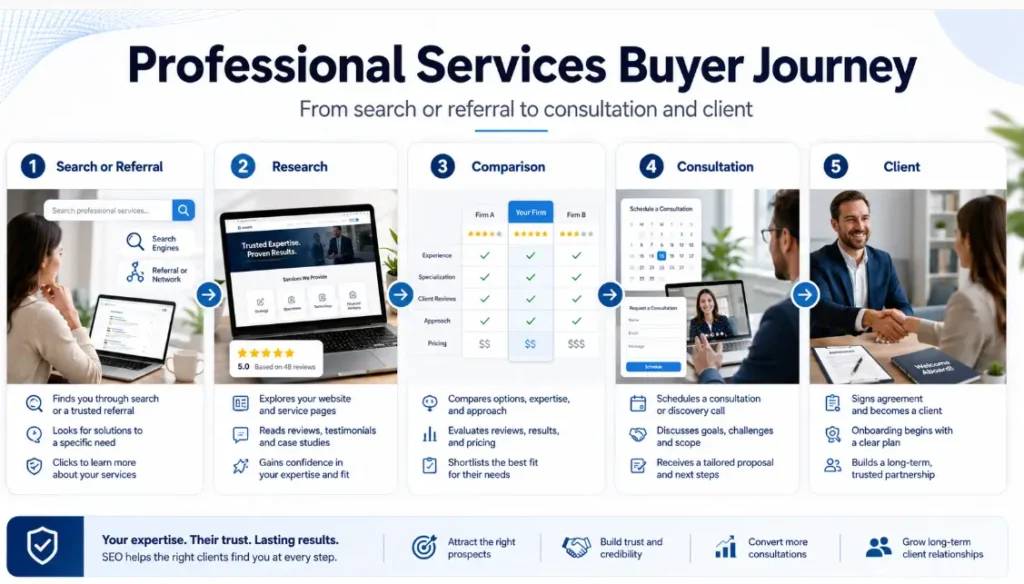
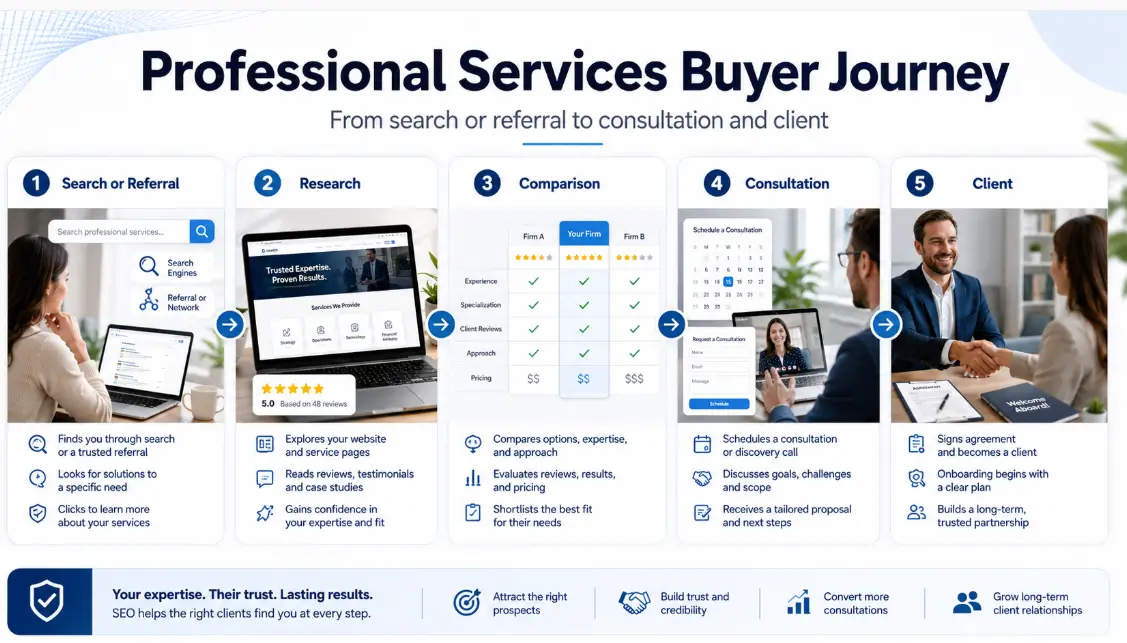
A potential client may hear your name through a referral, search your firm, compare your experts, read your service pages, and decide whether you are credible before anyone speaks to you. If your website gives vague answers while a weaker competitor explains the problem clearly, the competitor can win the enquiry.
SEO for professional services closes that gap. It helps the right buyers find your firm, understand its expertise, trust its people, and take the next step. The goal is not the largest possible traffic number. The goal is qualified demand for the services you actually want to sell.
| Quick answer
SEO for professional services is the process of improving a firm’s visibility when potential clients search for expertise, solutions, providers, and proof. It combines commercial keyword research, service page optimization, expert led content, local visibility, technical SEO, and authority building to generate qualified enquiries rather than empty traffic. |
What Is SEO for Professional Services?
Professional services SEO applies search optimization to firms that sell knowledge, judgment, experience, and specialist advice. Common examples include law firms, accountants, consultants, architects, engineers, recruiters, financial advisers, insurance brokers, property advisers, and specialist agencies.
The product is not sitting on a shelf. A buyer cannot judge it from a photo and a price. They must decide whether your team understands the problem, has solved similar problems, can manage risk, and is worth the fee. Your search strategy therefore has to do more than bring a page into Google. It has to make expertise visible and believable.
This is why professional services need a different page and content system from ecommerce SEO, where products, categories, pricing, and transactions dominate the search journey.
A useful professional services SEO strategy should help your firm appear during four moments:
- Problem discovery, when a buyer is trying to understand an issue.
- Solution research, when they compare approaches and service types.
- Provider evaluation, when they judge firms, experts, proof, and fit.
- Referral validation, when they search a recommended firm before making contact.
Why Professional Services SEO Is Different
Most SEO advice is written as if every visitor can make a quick purchase. Professional services rarely work that way. The sale may involve several decision makers, a long research period, regulatory concerns, confidential information, and a high financial or operational risk.
Trust has to arrive before the sales call
A buyer is not only asking, “Can this firm do the work?” They are also asking, “Will they understand our situation, protect us from mistakes, communicate clearly, and justify the cost?” Your pages need to answer those questions through specific services, named experts, credentials, relevant experience, client proof, and a clear working process.
Trust standards become even stricter in regulated or sensitive sectors. A firm serving health organizations, for example, should study the content and credibility principles used in healthcare SEO.
Search demand is often narrow but valuable
A broad phrase may attract more searches, but a narrow query can reveal stronger buying intent. “Consultant” is vague. “Supply chain consultant for food manufacturers” is a defined need. “Accountant” is broad. “Research and development tax accountant for software companies” describes a service, audience, and commercial problem.
Referrals still depend on search
A referral does not remove the need for SEO. It changes the query. The prospect may search your firm name, the partner’s name, reviews, case studies, office location, or a service mentioned by the referrer. A weak branded result can waste a strong introduction. A clear search presence helps the referral feel safer.
The buyer journey is longer
A homeowner who needs an emergency plumber may call within minutes. A company choosing legal counsel, an engineering partner, or a transformation consultant may research for weeks. That is why the content journey differs from home services SEO, where urgent local intent often drives faster action.
SEO priorities by professional firm type
| Firm type | High value search themes | Proof buyers need |
|---|---|---|
| Law and compliance | Urgent problem searches, specialist services, location, lawyer profiles | Credentials, outcomes where permitted, reviews, clear disclaimers |
| Accounting and tax | Service, business type, tax issue, software, location | Qualifications, deadlines, sector expertise, practical examples |
| Consulting | Business problem, sector, method, transformation goal | Named experts, frameworks, research, case evidence |
| Architecture and engineering | Project type, sector, capability, region | Portfolio, technical credentials, approvals, project experience |
| Financial advisory | Life event, planning need, audience, location | Licensing, process, fee clarity, trust and compliance |
| Recruitment and talent | Role type, sector, location, hiring problem | Market knowledge, candidate reach, employer outcomes, team expertise |
Where Most Professional Firms Lose Search Demand
The common failure is not a missing keyword in one title tag. It is a website built around the firm’s internal language rather than the client’s decision.
One vague services page
A page listing ten services gives Google and the reader no clear answer about any one of them.
Partner language instead of buyer language
Firms describe internal practice groups while prospects search for problems, outcomes, industries, and locations.
Thought leadership with no commercial path
Articles may sound intelligent but never connect the issue to a service, expert, case, or next step.
Thin expert profiles
A name, job title, and headshot do not prove subject authority.
No measurement beyond traffic
The firm cannot see which search terms create consultations, proposals, or revenue.
Generic proof
Claims such as trusted, leading, and results driven add little without evidence.
Disconnected pages
Service pages, articles, profiles, sectors, and locations do not link into a clear subject structure.
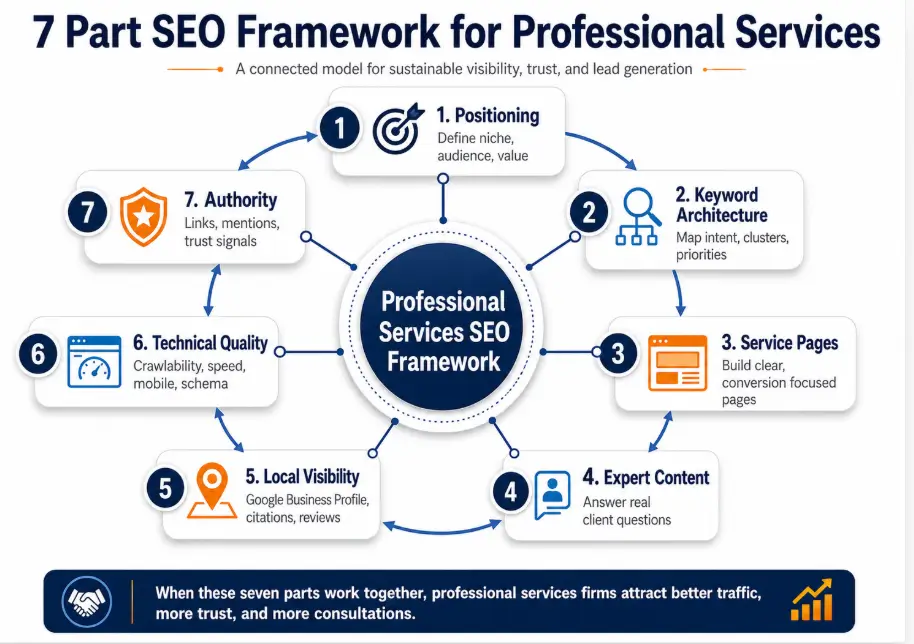
The Seven Part Professional Services SEO Framework
The framework below follows the way serious buyers think. Each part supports the next. Skipping the early positioning work usually creates weak keywords, generic content, and low quality enquiries later.
1. Start With the Work You Want More Of
Do not begin with a list of high volume keywords. Begin with commercial focus. Which services are profitable? Which client types are a strong fit? Which problems can your firm solve better than a general competitor? Which locations or sectors matter?
A useful focus statement looks like this: “We want more retained employment law work from technology companies with 50 to 500 employees in California.” That sentence gives the SEO strategy a service, audience, business size, sector, location, and commercial model.
Without that focus, keyword research becomes a report full of terms that look impressive but have no clear route to revenue.
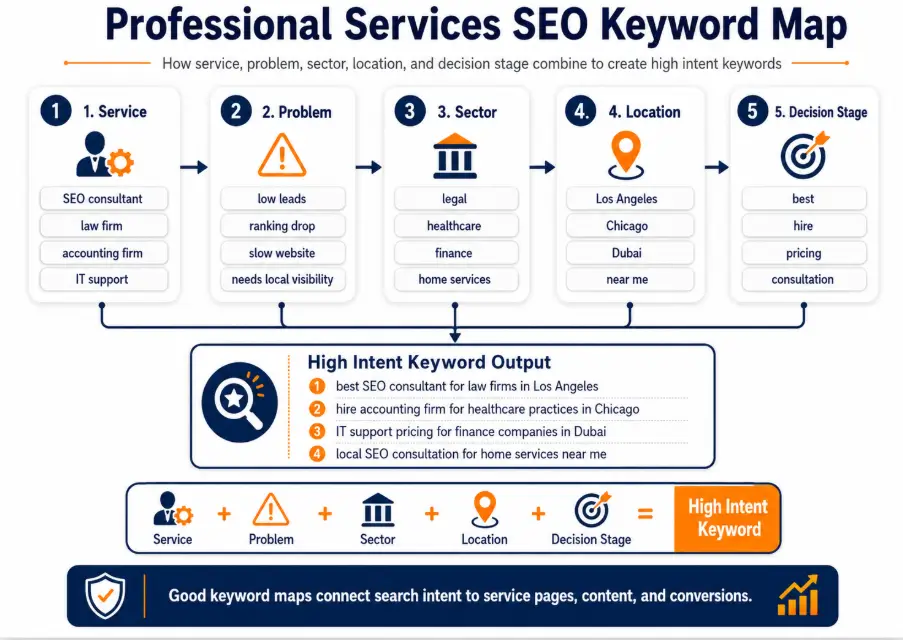
2. Build a Buyer Intent Keyword Map
Professional services keywords should be organized around five dimensions:
- Service, what the firm does.
- Problem, what the client is trying to fix or avoid.
- Sector, the client’s industry or operating context.
- Location, where the service is delivered or regulated.
- Decision stage, whether the person is learning, comparing, or ready to speak.
The strongest opportunities often combine two or three dimensions. “Business consultant” is broad. “Post merger integration consultant for healthcare groups” is much closer to a real buying situation.
Map each keyword group to one clear page. Do not force every variation onto the home page, and do not publish several near identical pages for wording changes. Google can understand related language. Your job is to create the best page for the need, not the most pages for the phrase.
3. Create Pages for Services, Problems, Sectors, and Locations
A professional services website needs a page architecture that mirrors the buying journey. The basic structure usually includes:
- Core service pages for the work you sell.
- Sector pages where industry context changes the service or proof.
- Problem pages for high value situations that clients actively research.
- Location pages where proximity, regulation, licensing, or regional experience matters.
- Expert profiles connected to relevant services, insights, and case evidence.
Every service page should answer the questions a qualified prospect would ask before a consultation: Who is this for? What problem does it solve? What is included? What is the process? What evidence supports the claim? Who will do the work? What affects cost and timing? What should the reader do next?
Titles, headings, copy, internal links, and page focus should be handled through disciplined on page SEO, not by repeating the target phrase in every paragraph.
4. Turn Expert Knowledge Into Searchable Proof
The best content source is often already inside the firm. It sits in partner calls, client questions, proposals, training notes, presentations, risk reviews, and project lessons. The content team should interview the experts and turn that knowledge into useful pages.
Strong formats include:
- Case studies that explain the situation, constraints, decisions, and result.
- Decision guides that compare options and tradeoffs.
- Original research based on anonymized firm data or market surveys.
- Practical checklists drawn from real delivery work.
- Expert commentary on regulatory or market changes.
- Detailed answers to questions raised during consultations and onboarding.
Avoid publishing another generic list that any firm could write. A page becomes source worthy when it includes a specific point of view, a method, a real example, a useful distinction, or evidence that did not exist elsewhere.
Connect every useful article to a relevant service page and expert profile. That gives the reader a next step and helps search engines understand the relationship between the firm’s knowledge and its commercial expertise.
5. Strengthen Local Visibility Where Location Matters
Local SEO matters when clients prefer a nearby adviser, regulations differ by region, the firm has physical offices, or search results display maps. Law, accounting, financial advice, recruitment, property, and many consulting services can all have meaningful local demand.
The core work includes accurate business information, a complete Google Business Profile, relevant categories and services, genuine reviews, consistent listings, location pages, local links, and clear evidence that the firm serves the area.
A multi office or regional firm should build a controlled system for profiles, reviews, citations, and landing pages through local SEO services.
Do not create dozens of city pages with the same copy and a changed place name. A useful location page should explain the office, experts, services, regional experience, directions, contact details, and local proof.
6. Fix Technical and On Page Friction
Strong expertise cannot rank if important pages are blocked, duplicated, slow, buried, or poorly linked. Professional services websites often collect old event pages, duplicate biographies, outdated PDFs, abandoned campaign pages, and overlapping service descriptions over time.
Technical priorities include crawlability, indexation, canonical signals, redirects, mobile usability, page speed, structured navigation, XML sitemaps, secure delivery, and a clear relationship between services, sectors, experts, locations, and insights.
A focused technical SEO review should identify which issues actually limit discovery or user experience. A long error export without business priority is not a strategy.
On the page, use one clear H1, descriptive subheadings, concise introductions, useful tables, specific examples, accessible images, and internal links that help the visitor continue the decision. The page should feel written for a busy managing partner, not for an SEO tool score.
7. Build Authority Beyond Your Website
Professional services authority is not built by collecting random links. It grows when credible organizations recognize the firm’s expertise. Useful sources can include professional associations, industry publications, universities, conference websites, partner organizations, trusted directories, podcasts, research citations, and media coverage.
The best link and mention opportunities often come from real firm activity: publish research, contribute expert commentary, speak at events, create useful tools, support associations, and make senior experts available to journalists.
That work belongs inside a selective off page SEO plan focused on relevance and reputation, not a monthly quota of weak placements.
How to Rank in Google AI Overviews and Chatbots
AI search does not make traditional SEO irrelevant. Google’s guidance updated in June 2026 says its generative search features are rooted in core search ranking and quality systems. The practical foundation remains useful content, crawlable pages, clear structure, and accurate business information. Use this AI search content optimization checklist to review whether your pages are structured for both traditional search results and AI generated answers.
For professional services firms, improve the chance of being understood and cited by doing the following:
- Give a direct answer near the start of each important page.
- Use clear service, sector, location, expert, and organization names.
- Publish original experience, methods, examples, and research rather than summaries of common advice.
- Support claims with named authors, dates, credentials, sources, and evidence.
- Use descriptive headings and tables so a reader can find the needed answer quickly.
- Keep critical information in crawlable page content rather than hiding it only inside images, videos, or scripts.
- Maintain consistent facts across the website, business profiles, trusted directories, expert profiles, and external coverage.
- Update pages when regulations, services, teams, locations, or market conditions change.
Do not waste time looking for a secret AI file or rewriting every paragraph into tiny chunks. Google says there is no special AI schema, no ideal page length, and no need to create content for every wording variation. Clear, original, useful pages remain the better investment.
A 90 Day Professional Services SEO Plan
The first 90 days should establish direction, repair the biggest barriers, and publish the pages closest to revenue. It should not try to complete every possible SEO task.
| Phase | Priority work |
|---|---|
| Days 1 to 30, foundation | Define priority services and ideal clients; review competitors and search results; complete keyword mapping; audit indexation, templates, speed, internal links, conversions, profiles, and tracking; choose quick wins and critical fixes. |
| Days 31 to 60, build | Rewrite or create priority service pages; improve expert profiles; connect services, sectors, locations, and insights; optimize the Google Business Profile where relevant; publish the first expert led decision guide; repair high impact technical issues. |
| Days 61 to 90, authority and learning | Publish a case study or original asset; begin targeted outreach and digital PR; improve reviews and citations; monitor rankings, enquiries, calls, and assisted conversions; refine pages using real query and sales feedback; plan the next content cluster. |
Begin with an SEO audit that ranks findings by revenue impact, search opportunity, implementation effort, and risk. Fixing one important template can be worth more than editing fifty low value blog posts.
How Much Does SEO for Professional Services Cost?
There is no honest universal price. Cost depends on the firm’s market, number of services and locations, site condition, competition, content needs, access to experts, and the level of implementation required.
The fee is usually shaped by four work areas:
- Strategy and research, including commercial focus, keyword mapping, competitor analysis, and measurement.
- Technical and on page implementation across templates, service pages, profiles, and internal links.
- Expert led content, case studies, research, and visual assets.
- Authority building, digital PR, relevant links, listings, and reputation support.
A smaller local firm with a clean site and a narrow service focus needs a different investment from a multi office legal or consulting group competing across several markets. Ask for a scope tied to priorities and deliverables, not a package defined only by a number of keywords or links.
The better question is not, “What is the cheapest monthly package?” It is, “Which search opportunities can produce valuable work, what must change to compete, and what evidence will show progress?”
How to Measure Results That Matter
Traffic is useful, but it is not the final score. A professional services SEO program should measure whether search is creating the right business conversations.
| Measurement level | What to track |
|---|---|
| Visibility | Priority service, problem, sector, and location queries; branded search presence; AI citations where measurable |
| Engagement | Visits to service pages, expert profiles, case studies, pricing or process information, and contact paths |
| Enquiries | Forms, calls, email clicks, booked consultations, and downloads from organic landing pages |
| Lead quality | Fit by service, sector, location, budget, urgency, and decision authority |
| Sales progress | Consultations, qualified opportunities, proposals, win rate, and sales cycle |
| Commercial impact | Pipeline value, closed revenue, client value, and cost per qualified opportunity |
Connect website analytics, Search Console, call tracking, forms, and the customer relationship system where possible. Review the actual enquiries with the sales or partner team. A keyword that creates ten poor leads may be less valuable than a narrow page that creates two strong opportunities.
When to Hire an SEO Specialist
A firm can handle some SEO internally when the website is small, the competition is modest, and a capable team has time to learn and implement the basics. Specialist help becomes more valuable when the firm is redesigning a site, entering a new market, losing visibility, managing several offices, working in a competitive niche, or struggling to connect content with revenue.
Ask a potential provider these questions:
- How will you identify the services and client types we should prioritize?
- How will you separate useful traffic from qualified demand?
- What technical, content, local, and authority work is included?
- How will you use our partners and subject experts without wasting their time?
- What access and implementation support will you need from us?
- How will you measure consultations, opportunities, and revenue from organic search?
- Which tactics will you avoid, and why?
- What should we expect in the first 30, 60, and 90 days?
Be cautious when a provider guarantees a ranking, promises instant results, sells a fixed number of links without discussing relevance, or cannot explain how the plan connects to the firm’s services and buyers.
Firms that need direction, prioritization, or support for an internal team can begin with SEO consulting before committing to a larger implementation program.
Frequently Asked Questions
Is SEO dead or evolving in 2026?
SEO is evolving, not dead. Google’s own 2026 guidance says core SEO practices remain relevant because AI Overviews and AI Mode use its search index, ranking systems, and quality systems. Firms now need to optimize for both discovery and source credibility, but the foundation is still useful content, crawlability, clear structure, and authority.
What is the 80 20 rule of SEO?
For professional services, the useful version of the 80 20 rule is to identify the small number of services, pages, and search themes most likely to create valuable enquiries, then prioritize them. It is not a fixed Google rule. It is a way to prevent teams from spending most of their time on low impact blog updates and minor tool warnings.
How do you market professional services with SEO?
Start with the services and clients the firm wants more of. Build pages around specific services, problems, sectors, and locations. Add expert led articles, case evidence, strong profiles, local visibility where relevant, technical quality, and trusted external mentions. Measure consultations and pipeline, not traffic alone.
How long does professional services SEO take?
Technical fixes and page improvements can create early movement, but competitive growth usually requires several months of consistent work. Timing depends on the site’s history, competition, authority, implementation speed, and the quality of the firm’s expertise and proof.
Should a professional services firm target local or national SEO?
Choose the market that matches how clients buy. Firms that rely on proximity, regional regulation, or offices should strengthen local visibility. Highly specialized firms can target national or international problem based searches. Many firms need both, with clear pages for each role.
Can SEO help a referral based firm?
Yes. SEO helps referred prospects validate the firm, its experts, services, reputation, and location. It also creates a separate source of demand from buyers who do not already know the firm.
Do professional services firms need special optimization for AI search?
They do not need a secret markup or separate AI version of every page. They need clear, crawlable, expert led content with accurate entities, strong evidence, useful structure, and consistent information across trusted sources.
Turn Expertise Into Qualified Demand
Professional services SEO works when the website reflects the way buyers make a serious decision. They need to find the firm, understand the service, recognize the expertise, reduce risk, and see a clear next step.
That requires more than publishing articles or adding keywords. It requires commercial focus, strong service pages, expert proof, technical clarity, local relevance where needed, and authority beyond the website. When those pieces support one another, search becomes more than a traffic channel. It becomes a system for earning trust before the first conversation.
The Rankxon SEO team can review your current visibility, identify the services with the strongest search opportunity, and build a plan around qualified enquiries. To discuss your firm, contact Rankxon.
