
You built a great business. You have a website. But when someone in your city searches for what you offer, you are nowhere to be found. That is a citation problem, and it is one of the easiest things to fix.
Local citations are how Google, Bing, and AI tools like ChatGPT confirm your business is real, legitimate, and relevant to a specific area. When your name, address, and phone number appear consistently across trusted directories, Google starts trusting you too. And that trust shows up in local rankings.
This guide walks you through every step: what citations are, which ones matter most, how to build them yourself for free, and how to keep them clean over time. Whether you are a solo contractor or running a multi-location brand, this is your starting point.
What Are Local Citations? (And Why They Still Matter in 2026)
A local citation is any online mention of your business that includes your name, address, and phone number. Collectively, these three pieces of information are called NAP.
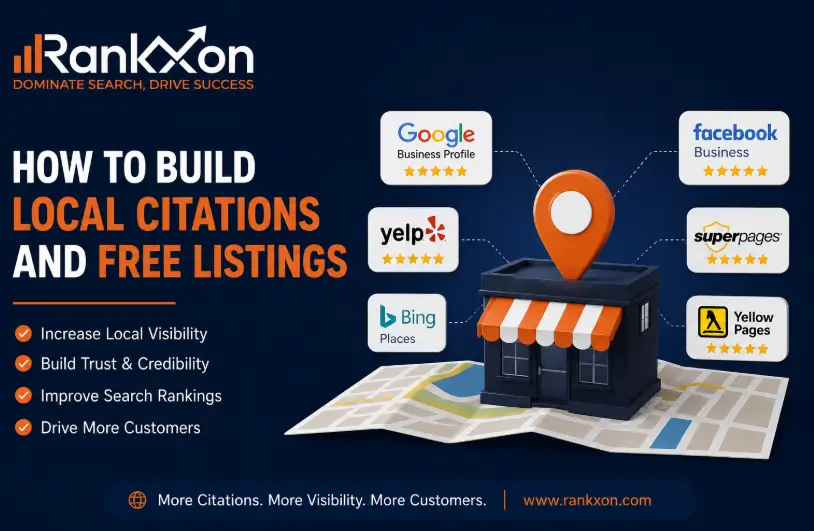
Citations show up on directories like Yelp, Yellow Pages, and Google Business Profile, but also on news sites, blogs, Chamber of Commerce pages, and industry-specific platforms. Google uses them as signals to confirm your business exists where you say it does.
Think of it this way: if 40 trusted websites all say your HVAC company is located at the same address and shares the same number, Google has strong confidence in that data. That confidence feeds directly into your local pack rankings.
Here is what citations affect:
- Your ranking in the Google local 3-pack (the map results)
- How AI tools like ChatGPT and Gemini describe your business in responses
- Your overall domain authority and trustworthiness
- Click-through rates from people discovering you on directories
Need the full picture on how local SEO works? Read our local SEO guide for context before diving into citations.
NAP Consistency: The Rule That Most Businesses Break
Before you build a single new listing, you need to understand the NAP consistency rule.
Your business name, address, and phone number must be identical across every directory. Not similar. Identical.
This means if your Google Business Profile says:
- Name: Rankxon Digital Agency
- Address: 123 Main Street, Suite 4
- Phone: (555) 123-4567
Then every other listing must say the exact same thing. Not “Suite #4” or “Ste. 4” or a different phone format. Inconsistencies confuse search engines and dilute your citation value.
Common mistakes people make:
- Using an old address on some listings after moving
- Listing the business as “LLC” in some places and not others
- Using a tracking phone number on directories that differs from the main number
- Abbreviating street types differently across listings (“St” vs “Street” vs “St.”)
Fix these before building new citations. One bad batch of inconsistent listings can undo months of work.
Step-by-Step: How to Build Local Citations from Scratch
Step 1: Gather Your NAP Information
Before you log into a single directory, open a document and write down your exact business details. Use this as your master reference for every listing you create.
Your NAP sheet should include:
- Exact business name (as registered)
- Full street address with suite or unit number
- Primary phone number
- Website URL
- Business hours for each day
- Short business description (150-200 words)
- Long business description (500-750 words)
- Business categories (primary and secondary)
- Logo file (PNG, min 250×250)
- Cover photo or business images
Having this ready saves hours. Most directories ask for the same information, and copying from a prepared sheet keeps everything consistent.
Step 2: Claim the Big Four First
These four platforms carry the most weight. If you only have time for a handful of listings, start here.
- Google Business Profile (google.com/business): This is the most important citation you will ever create. It controls your appearance in Google Maps, local search results, and increasingly, AI overview responses. Claim it, verify it, and fill out every single field.
- Bing Places for Business (bingplaces.com): Bing powers Microsoft Search and Cortana. It also feeds data to Alexa and some AI assistants. Once you claim your Google listing, you can import it directly into Bing, which saves time.
- Apple Maps (mapsconnect.apple.com): iPhone users represent a large portion of mobile search. If you are not on Apple Maps, you are invisible to them in navigation searches.
- Yelp (yelp.com): Yelp carries strong domain authority and its data feeds into dozens of other directories. Even in industries where you might not expect it, Yelp listings show up in Google results.
Step 3: Submit to High-Authority General Directories
After the Big Four, work through these established directories. Each one adds a layer of trust to your business profile.
- Facebook Business, strong branded visibility
- Yellow Pages, trusted long-term directory
- BBB, improves trust and credibility
- Foursquare, supports maps and apps
- MapQuest, useful for local discovery
- Manta, strong for small businesses
- Hotfrog, indexed across US markets
- Alignable, local business networking
- EZLocal, supports local search visibility
- MerchantCircle, popular with service businesses
- Superpages, trusted business directory
- ChamberofCommerce.com, local authority signal
- Cylex USA, industry and city listings
- ShowMeLocal, extra citation coverage
- Judy’s Book, review-based business listings
Want a free spreadsheet of 100+ USA citation sites ready to submit? Get the Rankxon Free USA Citation List and start building today.
Step 4: Find and Submit to Niche Directories
Industry-specific directories carry disproportionate authority for local ranking. A plumber listed on Houzz or a lawyer listed on Avvo sends a far stronger relevance signal than ten generic directories.
Examples by industry:
- Lawyers: Avvo, FindLaw, Justia, Martindale-Hubbell
- Doctors and dentists: Healthgrades, Zocdoc, WebMD, Vitals
- Home services: Houzz, HomeAdvisor, Thumbtack, Porch
- Restaurants: OpenTable, Zomato, TripAdvisor, DoorDash
- Accountants: CPAdirectory, AccountingToday
- Realtors: Zillow, Realtor.com, Trulia
To find more niche directories for your industry, search Google for: [your industry] + “add your business” or [your city] + “business directory”.
Step 5: Get Listed in Local and Regional Directories
These are often overlooked but carry strong geographic relevance signals.
- Your city’s Chamber of Commerce website
- Your state’s official business directory
- Local newspaper or magazine websites that list businesses
- Local event platforms or community boards
- Nextdoor Business (nextdoor.com): Neighborhood-level visibility
A business that appears on both national directories and local community sites signals deep geographic relevance to Google. That combination ranks well.
Top 20 Free USA Citation Sites: Authority and Impact at a Glance
Use this table as your submission checklist. Start at the top and work your way down.
| Directory | URL | DA/Authority | Cost | Key Benefit |
| Google Business Profile | google.com/business | Highest | Free | Maps, Search, AI Overviews |
| Yelp | yelp.com | Very High | Free | Reviews + Search |
| Bing Places | bingplaces.com | Very High | Free | Bing Maps, Cortana |
| Apple Maps | mapsconnect.apple.com | Very High | Free | iOS + Safari users |
| Facebook Business | facebook.com | High | Free | Social + Search |
| Yellow Pages | yellowpages.com | High | Free | YP search + partners |
| BBB | bbb.org | High | Free/Paid | Trust + reviews |
| Foursquare | foursquare.com | High | Free | Maps + apps |
| MapQuest | mapquest.com | Medium-High | Free | Map discovery |
| Angi | angi.com | Medium-High | Free | Home services niche |
| Hotfrog | hotfrog.com | Medium | Free | USA business index |
| Manta | manta.com | Medium | Free | Small business focus |
| Alignable | alignable.com | Medium | Free | B2B local network |
| ChamberofCommerce.com | chamberofcommerce.com | Medium | Free | Chamber authority |
| Cylex | cylex-usa.com | Medium | Free | Niche directories feed |
| EZLocal | ezlocal.com | Medium | Free | USA local search |
| Superpages | superpages.com | Medium | Free | Telecom-backed index |
| MerchantCircle | merchantcircle.com | Medium | Free | SMB community |
| Judy’s Book | judysbook.com | Low-Med | Free | Review-based listing |
| ShowMeLocal | showmelocal.com | Low-Med | Free | USA SMBs |
How to Find Citation Opportunities Your Competitors Are Using
One of the fastest ways to find high-value citation opportunities is to look at where your top-ranking competitors are listed.
Here is a simple manual method:
- Search Google for your main keyword, like “plumber in Austin TX” or “divorce lawyer Chicago”.
- Pick the top 3 businesses ranking in the map pack.
- Take their business name and search it in Google. Look at the directories where their information appears.
- Cross-reference against your own listings. Any directory they appear on that you do not is an opportunity.
For a more thorough approach, paste competitor URLs into a backlink tool like Ahrefs or Moz. Filter for .com directories and high-DA sites. This surfaces citation sources you would not find manually.
Understanding your site’s current backlink profile before starting citation building is smart. An SEO audit gives you a baseline to measure progress against.
Data Aggregators: The Silent Citation Builders
Most business owners have never heard of data aggregators, but they quietly power hundreds of directories across the web.
The main US aggregators are:
- Data Axle (formerly Infogroup)
- Foursquare
- Localeze (Neustar)
- Acxiom
These companies collect business data and distribute it to smaller directories, GPS systems, and apps. When your information is correct in these aggregators, it flows accurately to hundreds of downstream sources automatically.
Submitting to aggregators is worth doing early. It can take 4-6 weeks for changes to propagate, but the multiplier effect is significant.
Common Citation Mistakes That Kill Rankings
Knowing what not to do is as important as knowing what to do.
Duplicate business listings
Different phone numbers across directories
Old addresses left online
Keyword stuffing in business names
Wrong business categories
Incomplete profiles
Spammy directory submissions
Unverified listings
Missing logos or photos
Inconsistent website URLs
Ignoring reviews and updates
Using different NAP formats
Off-page SEO goes beyond citations. See how off-page SEO and citation building work together to strengthen your overall authority.
How Citations Impact AI Search Results (ChatGPT, Gemini, Perplexity)
This is the piece most guides from 2022 and 2023 miss entirely.
AI tools like ChatGPT, Google Gemini, and Perplexity now answer local business questions directly. When someone asks “who is the best electrician near me” or “is there a good Thai restaurant in downtown Denver”, these tools pull from web data, including directories.
What feeds AI citations? The same things that feed Google: consistent NAP across high-authority sites, detailed descriptions, genuine reviews, and structured data on your website.
Businesses with strong citation profiles are more likely to be surfaced in AI responses. It is not guaranteed, but it is directional. More authoritative mentions across the web means more chances for AI to reference you accurately.
For this reason, the quality of your business description matters now more than ever. Write 400-600 words that clearly describe what you do, who you serve, and where you operate. Use this description consistently across your top listings.
How to Track and Maintain Your Citations Over Time
Building citations is not a one-time task. Businesses move, phone numbers change, and directories sometimes auto-update your information with incorrect data pulled from other sources.
Here is a simple maintenance system:
- Keep a master spreadsheet of every directory you submit to, including the login credentials and submission date.
- Set a calendar reminder to audit your top 20 listings every 6 months.
- After any business change (address, phone, hours), update your GBP first, then work through your list.
- Use a free tool like Moz Local’s Check Listing or BrightLocal’s Citation Tracker for periodic audits.
- Monitor for duplicate listings by searching your business name in Google and clicking through results.
Good citation hygiene is an ongoing part of local SEO, not a campaign you run once and forget.
Curious about which factors move the needle in local search? Read our breakdown of SEO ranking factors to see where citations fit in the bigger picture.
Structured Data: Making Citations Even More Powerful
Citations on external sites are one signal. But Google also reads the structured data on your own website.
Adding LocalBusiness schema markup to your site tells search engines exactly who you are, where you are, and what you do. It reinforces your citations and improves how Google interprets your site.
Your schema should include:
- Business name, address, phone (matching your citations exactly)
- Business hours
- Geographic coordinates (latitude and longitude)
- Business category from schema.org vocabulary
- Logo URL
- Website URL
Schema markup alone will not rank you. Combined with a strong citation profile, it becomes a consistency signal that search engines value.
Wondering how technical factors like HTTPS impact SEO? These details add up when you are chasing local pack positions.
Building Citations for Multiple Locations
If your business has more than one physical location, each location needs its own citation profile.
That means:
- A separate Google Business Profile for each address
- Separate Yelp, Bing Places, and Apple Maps listings for each location
- Location-specific pages on your website that these citations link to
- Different local phone numbers per location (not a centralized line)
Aggregating multiple locations under one listing is a common mistake. It dilutes your geographic relevance for each area and makes it harder to rank in multiple markets.
Multi-location citation building pairs well with a solid link building strategy to give each location page the authority it needs.
Free Citation Tools Worth Using
You do not need to pay for a tool to build citations. These free resources help at every stage:
Google Search, competitor citation research
Google Sheets, citation tracking
Moz Local Check, NAP audit
BrightLocal Checker, local rank tracking
Ahrefs Free Backlink Checker, competitor directories
Bing Places Scan Tool, listing sync
GBP Manager, profile management
Schema Markup Generator, LocalBusiness schema
Canva, logos and business images
Wayback Machine, old citation checks
External validation of citation best practices, resources from Moz and BrightLocal are reliable references used by SEO professionals across the industry.
What a Real Citation Looks Like in Practice
Here is an example. Say you own a landscaping company called Green Edge in Denver, CO.
A well-optimized Yelp citation might look like this:
- Business Name: Green Edge Landscaping
- Address: 742 Elm Street, Denver, CO 80203
- Phone: (303) 555-0192
- Website: greeredgelandscaping.com
- Category: Landscaping, Lawn Care
- Hours: Mon-Fri 7am-6pm, Sat 8am-4pm
- Description: (full, keyword-rich description of services, areas served, and what makes the business different)
- Photos: 5-10 quality images of completed work
That same information, replicated across 50-80 directories with minor natural variations in description but identical NAP, builds a citation footprint Google cannot ignore.
Frequently Asked Questions
How many citations do I need to rank locally?
There is no magic number. In a small city with low competition, 30-50 quality citations might be enough. In a major metro like New York or LA competing in a saturated niche, you might need 100+. Audit your top competitors and match or beat their citation count.
Do citations from low-quality directories hurt me?
Generally, no. A low-quality citation is usually just ignored rather than penalized. That said, spending time building citations on spam directories is wasted effort. Focus on sites with real traffic and domain authority above 20.
How long does it take to see results from citation building?
Most businesses see movement in local rankings within 4-8 weeks of cleaning up inconsistencies and building foundational citations. Full impact, especially from niche and local directories, often takes 3-6 months.
Can I pay someone to build citations for me?
Yes, and it is often worth it for the time savings. Services like BrightLocal, Whitespark, and Loganix offer citation building. Just make sure they use manual submission, not automated tools that can create duplicates.
If you want expert help with your local visibility strategy, SEO consulting can speed up the process considerably.
Conclusion
Citation building is not glamorous. It is repetitive, detail-oriented work. But it is foundational to local SEO in a way that most other tactics are not. Google needs to trust your business information before it will show you to people searching nearby.
Start with NAP consistency. Claim the Big Four. Work through the authority directories. Find your niche-specific platforms. Then maintain everything twice a year.
That is it. No tricks. No shortcuts. Just consistent, accurate information in the right places, and Google will reward you for it.
If you are serious about ranking locally, pair this citation work with a proper local SEO strategy. The two together are far more powerful than either alone.
