


Most websites do not lose rankings overnight. They lose rankings quietly. A few broken internal links here. A few slow pages there. A few pages indexed but not ranking. Then one day traffic drops and everyone starts asking what happened.
That is exactly why SEO audits matter. But auditing too often wastes time, while auditing too late costs rankings, leads, and sales.
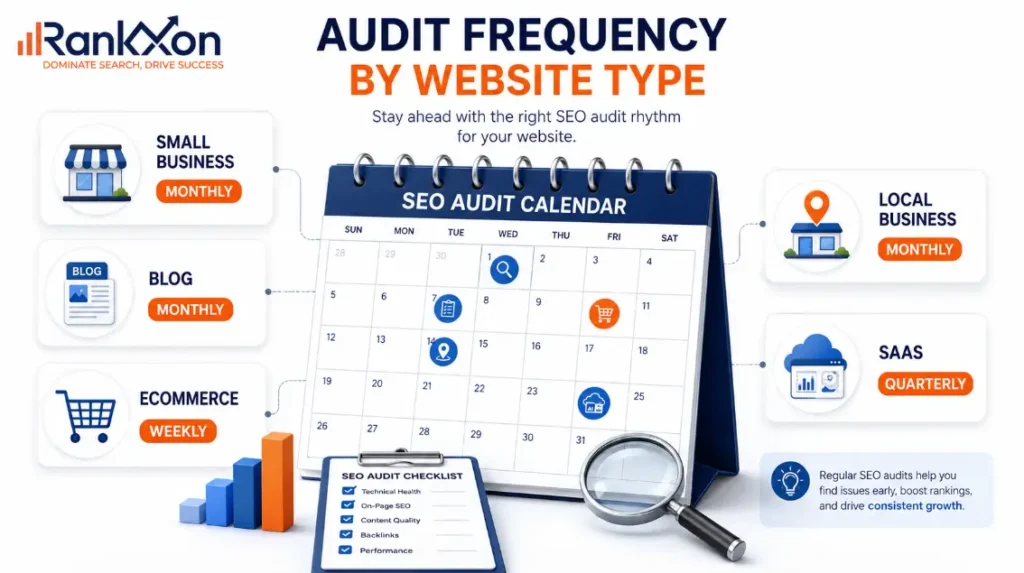
So, how many times should you audit your site for SEO? For most active websites, a full SEO audit every 3 to 6 months is the safest schedule. Small static websites may only need one every 6 to 12 months. Ecommerce sites, large blogs, and competitive websites usually need monthly checks plus a deeper quarterly audit.
Quick Answer By Website Type
The right audit schedule depends on how often your website changes and how much your business depends on organic traffic. Use this table as the starting point.
| Website Type | Recommended Audit Frequency | Why This Schedule Makes Sense |
| Small static business site | Every 6 to 12 months | The site does not change often, so the risk is lower. Still, technical errors, outdated content, and tracking issues can build up. |
| Local service business | Every 3 to 6 months | Local rankings, service pages, Google Business Profile signals, and competitors can shift quickly. |
| Blog or content site | Every 3 months | New posts can create cannibalization, thin content, weak internal links, or outdated articles. |
| Ecommerce website | Monthly light audit, quarterly deep audit | Product pages, filters, stock changes, duplicate URLs, and category pages create constant SEO risk. |
| SaaS or lead generation site | Every 3 months | Landing pages, comparison pages, content assets, and conversion paths need regular checks. |
| Large or high traffic website | Monthly checks, quarterly full audit | Small technical issues can affect many pages and a lot of traffic. |
| Website after migration or redesign | Before and after launch | Redirects, canonicals, indexation, internal links, and tracking can break during the move. |
Why There Is No Single Perfect Audit Frequency
A lazy answer is “audit your site regularly.” That advice is trash because it does not tell a business owner what to do next.
A 10 page local plumbing website does not need the same audit schedule as a 5,000 page ecommerce store. A blog publishing 40 posts per month does not carry the same SEO risk as a small portfolio site that changes twice a year.
Your audit frequency should depend on four things:
- How many pages your website has
- How often you publish or edit content
- How much revenue depends on organic traffic
- How often your rankings, competitors, or technical setup change
If your website is simple, audit less often. If your website changes often or organic traffic brings real revenue, audit more often.
For deeper issue discovery, connect this article naturally to SEO audit services. This is the most relevant internal link because the reader is already thinking about audit timing.
SEO Audit Frequency By Audit Type
Not every SEO check needs to be a full audit. This is where many site owners waste time. A quick GSC check is not the same as a complete SEO audit, and a full audit is not needed every week for most websites.
| Audit Type | Best Frequency | What To Check |
| Technical SEO check | Monthly for active sites, quarterly for smaller sites | Crawl errors, indexation, sitemap, robots file, canonicals, redirects, site speed, mobile usability. |
| Content audit | Quarterly | Outdated pages, cannibalization, thin content, poor search intent match, low CTR pages. |
| On page audit | Quarterly | Titles, meta descriptions, headings, internal links, image alt text, schema, page intent. |
| Backlink audit | Quarterly or every 6 months | Lost links, toxic patterns, irrelevant backlinks, anchor text issues, competitor authority gaps. |
| Local SEO audit | Every 3 months | Google Business Profile, citations, reviews, location pages, map rankings, NAP consistency. |
| Full SEO audit | Every 3 to 6 months for active sites | Technical, content, on page, off page, local, UX, analytics, and competitor gaps. |
| Strategy audit | Once or twice a year | Keyword direction, topical authority, content roadmap, internal linking, and ROI. |
If the issue is crawlability, indexation, page speed, schema, redirects, or site architecture, send readers to technical SEO because this section is directly connected to technical audit work.
When To Audit Outside Your Normal Schedule
A fixed schedule is useful, but some moments should trigger an audit immediately. Waiting for the next quarterly review can be expensive.
| Trigger | Audit Needed | Why It Matters |
| Organic traffic drops suddenly | Immediate audit | A drop can come from indexation issues, algorithm impact, lost links, content decay, or technical errors. |
| Website redesign | Before and after launch | Design changes can break headings, internal links, speed, tracking, and crawl paths. |
| Site migration | Before launch, launch day, 2 weeks after launch | Redirects, canonicals, XML sitemaps, URL structure, and indexation must be checked. |
| Major Google update | Light audit first, deeper audit if traffic changes | You need to compare affected pages, intent match, content quality, and ranking signals. |
| Large content push | Audit after publishing cycle | New content can create duplication, weak internal linking, and keyword overlap. |
| New CMS, theme, or plugin | Immediate technical check | CMS changes can affect speed, schema, noindex tags, canonical tags, and page templates. |
| Important page indexed but not ranking | Immediate page level audit | Indexing alone does not mean Google sees enough relevance, quality, authority, or intent match. |
If a page is already indexed but still invisible in search, link to indexed not ranking because that problem needs a page level diagnosis, not just a normal audit schedule.
Daily, Weekly, Monthly, Quarterly, And Yearly SEO Checks
Here is the cleanest way to think about it. You do not need a full audit every day. You need monitoring often and deep review on a set schedule.
| Timeframe | What To Do | Tools To Use |
| Daily | Check sudden traffic drops, conversion issues, website downtime, and important alerts. | Google Analytics, Search Console, uptime monitor. |
| Weekly | Review impressions, clicks, top losing pages, indexing alerts, and major ranking movement. | Google Search Console, rank tracker, analytics. |
| Monthly | Run a light technical and content health check for active websites. | Screaming Frog, Semrush, Ahrefs, PageSpeed Insights. |
| Quarterly | Run a deeper audit across technical SEO, content quality, internal links, and backlinks. | Crawler, GSC, GA4, backlink tool, manual SERP review. |
| Yearly | Review full SEO strategy, topical authority, competitor gaps, lead quality, and revenue impact. | Keyword database, analytics, CRM, content inventory. |
How To Choose Your Audit Schedule
Use this simple risk system. Count how many of these apply to your site:
- You publish new content every week
- Organic traffic brings leads or sales
- Your website has more than 100 pages
- Your site has product pages, filters, or faceted URLs
- You recently changed your design, CMS, theme, or URL structure
- You compete in a crowded niche
- Your rankings have moved up or down in the last 60 days
If only 1 or 2 apply, audit every 6 months. If 3 or 4 apply, audit every 3 months. If 5 or more apply, run monthly light audits and quarterly deep audits.
If the site owner does not know how to judge risk, that is where SEO consulting fits naturally. A consultant can turn audit data into a clear plan instead of another list of errors.
What Should Be Checked During Each SEO Audit?
A useful SEO audit should not be a tool export with hundreds of warnings. It should explain what is wrong, why it matters, and what to fix first.
At minimum, check these areas:
- Crawlability and indexation
- XML sitemap and robots file
- Canonical tags and redirect chains
- Page speed and Core Web Vitals
- Mobile usability
- Title tags and meta descriptions
- Heading structure and search intent match
- Internal links and orphan pages
- Thin, duplicate, or outdated content
- Schema markup
- Backlink quality and lost links
- Local SEO signals for local businesses
- Conversion paths and calls to action
For local businesses, add a deeper review of map rankings, reviews, citations, service areas, and local landing pages. That is where local SEO becomes the most relevant next page.
Mistakes That Make SEO Audits Useless
The audit itself is not the win. The fix is the win. Many businesses audit their site and still do not grow because they treat the report like a trophy instead of an action plan.
Avoid these mistakes:
- Auditing too often but fixing nothing
- Only using automated tool scores
- Ignoring search intent and content quality
- Checking technical errors but not internal linking
- Auditing after traffic drops but not before big site changes
- Treating every issue as equal priority
- Updating pages without checking cannibalization
A strong audit should separate urgent problems from low impact noise. A missing title tag on a dead page is not the same as a noindex tag on a money page.
To strengthen topical relevance, link this section to ranking factors because the reader needs to understand which fixes actually affect ranking potential.
FAQs
How often should you do a full SEO audit?
Most active websites should do a full SEO audit every 3 to 6 months. Small static websites can usually audit every 6 to 12 months, while ecommerce and high traffic websites need monthly checks plus deeper quarterly reviews.
Is a monthly SEO audit too much?
A full monthly audit is too much for most small websites. But a monthly light check is useful for active sites. Check indexing, broken links, traffic drops, rankings, Core Web Vitals, and important page changes.
Should I audit my website after a Google update?
Yes, but do not panic audit every page immediately. First compare traffic, rankings, affected pages, and search intent. If your important pages dropped, run a deeper audit to find content, technical, or authority problems.
How often should a small business audit its website?
A small business website should usually be audited every 3 to 6 months if it depends on local leads. If the site is small and rarely updated, every 6 to 12 months may be enough.
How often should ecommerce websites be audited?
Ecommerce websites should get monthly light audits and quarterly deep audits. Product pages, filters, category URLs, out of stock items, duplicate content, and crawl budget issues can create problems quickly.
What is the difference between monitoring and an SEO audit?
Monitoring means checking key metrics like clicks, impressions, rankings, and errors. An SEO audit is a deeper review that diagnoses technical, content, on page, backlink, and strategy problems with a fix plan.
Do new websites need SEO audits?
Yes. A new website should be audited after the first 30 to 60 days, then quarterly during early growth. This helps catch crawl, indexing, tracking, content, and internal linking issues before they slow performance.
Can an SEO audit improve rankings?
An audit alone does not improve rankings. The improvements come from fixing the right issues after the audit, such as crawl problems, weak content, poor internal links, slow pages, missing schema, and authority gaps.
Conclusion
If your website is small and rarely changes, audit it every 6 to 12 months. If your site brings leads, gets regular content updates, or competes in a serious niche, audit it every 3 to 6 months. If you run an ecommerce store, large blog, SaaS site, or high traffic website, do monthly health checks and a deeper quarterly audit.
And if you redesign, migrate, lose rankings, publish a large batch of pages, or see a sudden traffic drop, audit immediately. Do not wait for the next planned review.
The real goal is not to audit more. The goal is to catch the problems early enough that they do not turn into ranking losses.
